


Table of Contents
- Why Your Hurricane Food Plan Needs More Than Canned Beans
- How Much Food to Store for Hurricane Season: A Per-Person Formula
- The Best Emergency Food Supplies: What Actually Lasts
- Your Non-Perishable Food List for Emergencies: Staples and Comfort
- Emergency Food Storage Tips for Power Outages and Flooding
- Cooking Without Power: Simple Meal Ideas That Work
- Conclusion: Build Your Hurricane Food Kit Before the Warning
- Frequently Asked Questions
Last Updated: September 7, 2026
When a hurricane warning is issued, grocery store shelves empty within hours. The best emergency food supplies for hurricanes are the ones you have stocked and organized before the storm ever forms. The most common gap in preparedness is food: people buy a few cans, assume they are covered, and then discover they have nothing to cook with when the power goes out.
A solid hurricane food plan maintains energy, morale, and safety during a multi-day ordeal. This guide covers how much to store per person, which foods last, how to keep supplies safe during flooding, and how to prepare meals without electricity or gas.
Why Your Hurricane Food Plan Needs More Than Canned Beans
The biggest mistake is assuming any non-perishable item will do. Canned beans are shelf-stable and filling, but a diet of nothing but beans will drain your energy and morale within two days. Build a balanced reserve that includes protein, carbohydrates, fats, and comfort foods.
Your emergency food supplies should mirror what your family normally eats in shelf-stable form. Stress suppresses appetite, and familiar foods encourage people to eat when they need calories most.
Think in categories: quick-energy snacks, substantial meals, and comfort foods. That last category is what most guides miss.
How Much Food to Store for Hurricane Season: A Per-Person Formula
A practical rule is a minimum of three days, with seven to fourteen days being far safer. Power outages after a hurricane frequently last a week or more, and road access may be blocked longer.
Calorie needs vary by age, body size, activity level, and individual health needs. When building an emergency food supply, use the normal daily needs of each person in your household as your guide and make sure you store enough food for the number of days you plan to be without normal access to groceries or cooking.
Household Size |
3-Day Supply |
7-Day Supply |
14-Day Supply |
|---|---|---|---|
1 adult |
6,000 calories |
14,000 calories |
28,000 calories |
2 adults |
12,000 calories |
28,000 calories |
56,000 calories |
Family of 4 |
24,000 calories |
56,000 calories |
112,000 calories |
Water is the non-negotiable companion to food. Store at least one gallon per person per day for drinking and basic hygiene, and add extra for warmer climates. A family of four needs a minimum of 28 gallons for a week, which is why FEMA's official emergency preparedness guidance provides additional information on building an emergency plan and preparing supplies for your household.
The Best Emergency Food Supplies: What Actually Lasts
The best emergency food supplies balance three factors: shelf life, calorie density, and ease of preparation. Freeze-dried and dehydrated foods lead on shelf life, often lasting 20 to 25 years when stored properly, while canned goods typically last two to five years.
For long-term storage, a dedicated emergency food bucket is the most efficient option. Our 14-Day Emergency Survival Food Bucket provides a full two-week supply of meals with an extended shelf life of up to 25 years when kept in a cool, dry location. At $141.39, it works out to roughly $10 per person per day for complete meals.

Canned goods remain the budget-friendly backbone of any hurricane food plan. They require no water to prepare and are widely available. The trade-off is weight and shorter shelf life compared to freeze-dried options.
Your Non-Perishable Food List for Emergencies: Staples and Comfort
Organize your non-perishable food list for emergencies into three tiers: daily staples, high-energy snacks, and comfort foods. Each serves a distinct purpose during a power outage. Here is a budget-friendly approach that prioritizes calories per dollar.
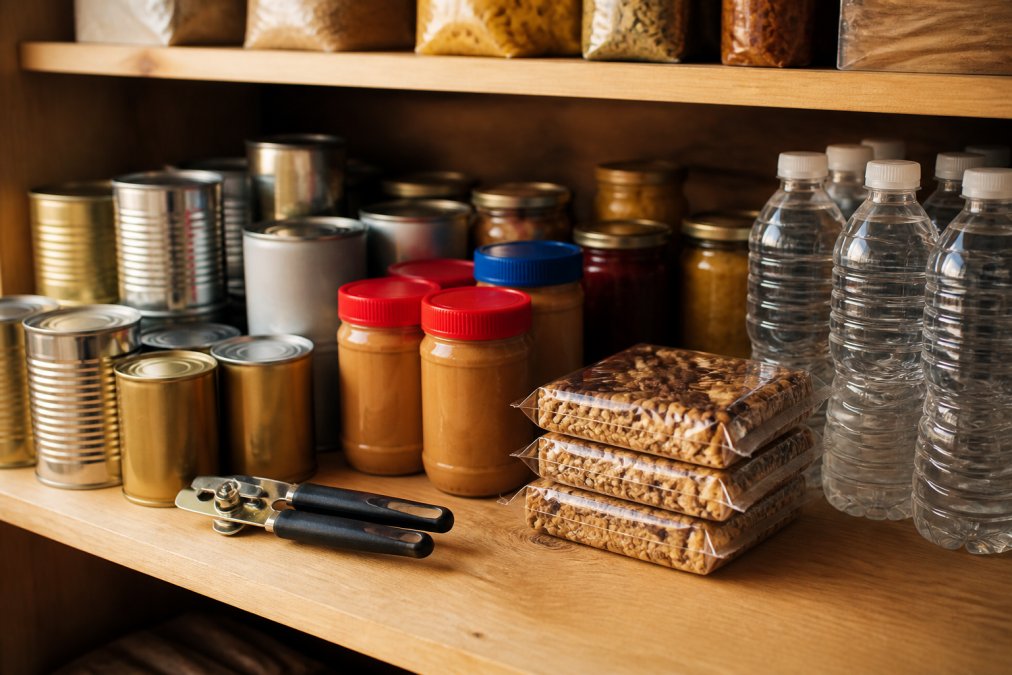
Daily staples form the backbone of your meals: canned meats, vegetables, and fruits; peanut butter; whole grain crackers; oatmeal; rice; and pasta. Include a manual can opener in every kit.
High-energy snacks keep morale and blood sugar stable: protein bars, trail mix, granola bars, and shelf-stable electrolyte drinks. During storm cleanup, these quick calories matter as much as full meals.
Comfort foods are the category competitors overlook. Instant coffee, tea, chocolate, hard candies, and canned soups your family loves can transform a grim situation. CDC guidance on food safety during power outages notes that keeping a familiar routine helps families cope with disaster stress, and food is central to that routine.
A Hurricane Prep on a Budget Shopping List
Here is a sample shopping list for a family of four aiming for a 7-day supply, with estimated costs based on typical national grocery store prices. The goal is to stay under $150 by focusing on versatile, calorie-dense items.
Item |
Quantity |
Estimated Cost |
Purpose |
|---|---|---|---|
Canned tuna or chicken (12.5 oz) |
8 cans |
$16.00 |
Protein for meals |
Canned black beans or chili (15 oz) |
12 cans |
$12.00 |
Fiber and protein |
Canned vegetables (mixed, 15 oz) |
8 cans |
$8.00 |
Vitamins and sides |
Canned fruit (peaches, pears, 15 oz) |
6 cans |
$9.00 |
Natural sugar and morale |
Peanut butter (16 oz jar) |
2 jars |
$6.00 |
High-calorie protein |
Whole grain crackers (box) |
4 boxes |
$8.00 |
Staple for snacks and meals |
Instant oatmeal (42 packets) |
1 box |
$5.00 |
Hot breakfast without power |
White rice (2 lb bag) |
2 bags |
$4.00 |
Bulk calories |
Pasta (1 lb box) |
4 boxes |
$4.00 |
Bulk calories |
Pasta sauce (24 oz jar) |
4 jars |
$6.00 |
Flavor and moisture |
Granola or protein bars (12-pack) |
2 boxes |
$10.00 |
Quick energy |
Trail mix (16 oz bag) |
2 bags |
$10.00 |
Snacking and calories |
Instant coffee (8 oz jar) |
1 jar |
$7.00 |
Comfort and routine |
Dark chocolate (bar) |
4 bars |
$6.00 |
Morale boost |
Hard candies (bag) |
1 bag |
$3.00 |
Quick sugar and comfort |
Total |
~$114.00 |
This list provides roughly 1,800-2,200 calories per person per day for a week. It is filling, familiar, and affordable. Buy these items a few at a time during regular grocery trips, add two items to your cart each week, and you will have a full supply before hurricane season peaks.
Shop Emergency Food Supplies →
Emergency Food Storage Tips for Power Outages and Flooding
Heat, humidity, and floodwater are the three enemies of your food supply, and each requires a specific defense.
Store everything in a cool, dry place, ideally below 75 degrees Fahrenheit. Avoid attics and garages that bake in summer sun, and keep food off the floor by at least a few inches in case of flooding.
Water-resistant or waterproof storage containers can provide an extra layer of protection for emergency food supplies in hurricane-prone areas. Plastic totes with tight lids, or the bucket packaging used by commercial emergency food, protect against both floodwater and pests. If floodwater does touch packaged food, discard anything that is not in a sealed, waterproof container. USDA food safety guidelines for emergency preparedness warns that contaminated food can cause serious illness, and the risk is not worth taking.
Managing Your Fridge and Freezer After the Power Goes Out
A full freezer keeps food safe for about 48 hours if the door stays closed; a half-full freezer lasts about 24 hours. A refrigerator keeps food safe for only about 4 hours. After those windows, bacteria multiply rapidly.
Here is a practical post-storm food waste management plan:
- Know your thresholds. If the power has been out for less than 4 hours, refrigerated food is safe. If it has been out for more than 4 hours, move what you can to a cooler with ice. For the freezer, if food still has ice crystals or is at 40°F or below, it is safe to refreeze.
- When in doubt, throw it out. Perishable items like meat, poultry, fish, eggs, and leftovers should be discarded if they have been above 40°F for more than 2 hours. Do not rely on smell alone; some bacteria produce no off-odor.
- Prepare a disposal zone. Designate a spot away from your shelter and living areas for spoiled food. Use heavy-duty trash bags, double-bagging if needed, and seal them tightly. This prevents attracting pests and keeps the smell from compounding your stress.
- Document for insurance. Take photos of spoiled food before disposal. Many homeowners' insurance policies cover food loss from power outages, but you will need evidence for a claim. Check your policy now, not after the storm.
- Sanitize surfaces. After removing spoiled food, clean the fridge and freezer interior with a solution of 1 tablespoon of unscented liquid chlorine bleach per gallon of water. Let it air dry. This prevents cross-contamination when you restock.
People often focus on storing food but forget the disposal plan. Having supplies, heavy-duty bags, bleach, gloves, and a designated disposal area, turns a chaotic situation into a manageable chore.
Cooking Without Power: Simple Meal Ideas That Work
Cooking without power is a skill you should practice before you need it. The safest options are a camp stove used outdoors, a portable grill, or a solar-powered setup. Never use charcoal or gas grills indoors, carbon monoxide is a silent killer.
A portable power station changes the calculus entirely. Our 1200W Portable Power Station at $429.00 can power compatible small appliances and charge devices without the exhaust produced by fuel-burning generators. Always follow the manufacturer's operating and safety instructions.. Pair it with a 200W Foldable Solar Panel to recharge when the grid is down for extended periods.

For no-cook meals, focus on combinations that need no heat: peanut butter on crackers with canned fruit, tuna salad with shelf-stable mayo packets, and protein bars with electrolyte drinks. With a camp stove, oatmeal, canned soup, and rice dishes become hot meals with minimal fuel.
Camp stove fuel usage varies by stove, fuel type, heat setting, and conditions, so check the manufacturer's specifications and keep enough fuel for the meals you expect to prepare.
Conclusion: Build Your Hurricane Food Kit Before the Warning
Waiting until a hurricane warning means competing with everyone else for limited supplies. Building your emergency food supplies now, when shelves are full, is the single most effective step you can take.
Start with a three-day supply, then extend it to seven and fourteen days as your budget allows. Include shelf-stable staples, high-energy snacks, and comfort foods, and verify you have a way to cook and a manual can opener. Store everything in waterproof containers in a cool location, and rotate your stock regularly.
At Already Survival, we make this simple with pre-assembled options. Our Hurricane Emergency Kit at $159.99 bundles food and water essentials, first aid supplies, lighting tools, and hygiene products in a portable backpack, ready for sheltering at home or evacuation. Every order ships free with a 30-day return policy on unused items, so you can prepare with confidence. Explore our emergency preparedness supplies and build a hurricane food plan that fits your household's needs.

Frequently Asked Questions
How much emergency food should I store per person for a hurricane?
Plan for a minimum of 3 days, but 2 weeks is safer for hurricane season. The general rule is 2,000 calories per person per day. For a family of four, that means roughly 24,000 calories total for 3 days. Use the formula of 3 meals plus 2 snacks per person daily when building your supply. A pre-assembled option like the 14-Day Emergency Survival Food Bucket simplifies the math and provides 14 days of meals per bucket.
What are the best non-perishable foods to stock for a hurricane?
Focus on shelf-stable items that need no refrigeration and little to no cooking. Prioritize canned meats like tuna and chicken, hearty soups, peanut butter, nuts, granola and protein bars, dried fruits, and whole grain crackers. Include canned vegetables and fruits for nutrients. Add comfort items like instant coffee, chocolate, and hard candy. Remember a manual can opener and disposable utensils. These items form the core of any solid non-perishable food list for emergencies.
How should I store emergency food supplies to keep them safe?
Store your emergency food in a cool, dry place, away from direct sunlight and temperature extremes. A pantry or closet on an interior wall works well. Keep items off the floor in waterproof plastic bins to protect against flooding. Check expiration dates every 6 months and rotate older items into your daily meals. Write the date on new purchases so you always know what to use first. Proper emergency food storage tips like these extend shelf life and prevent waste.
What foods should I avoid in my hurricane emergency kit?
Skip anything highly perishable like fresh meat, dairy, and eggs. Avoid foods that require extensive cooking or water to prepare, since both may be scarce. Salty snacks that increase thirst are also a poor choice. Stay away from glass jars that can shatter in a storm. Instead, choose nutrient-dense, shelf-stable options that are ready to eat or need only a splash of bottled water to prepare.


