


Last Updated: November 4, 2026
Quick Summary
For an apartment balcony, choose a portable power station whose continuous and surge output ratings cover the appliances you plan to run at the same time, and whose capacity covers how long you need them. A 200W compact unit suits phones, laptops and small devices. Match the unit's output and watt-hour capacity to the appliances you plan to run.
- The 200W compact unit (172.8Wh) suits phones, tablets, laptops and small appliances.
- The 1200W unit has four AC outlets and six USB ports for many everyday loads; its capacity and surge rating are pending confirmation.
- The 2400W listing linked here includes a 200W foldable panel; whether a panel is included depends on the listing and variant you select.
- Refrigerators draw more power at compressor startup, so check the appliance's startup wattage first.
- Keep the unit dry, out of direct sun and within its stated operating temperature range.
Table of Contents
- Why Apartment Balconies Need a Different Kind of Power Plan
- How We Chose These Four Portable Power Stations for Apartment Balconies
- Quick Comparison: Four Portable Power Stations at a Glance
- Portable Power Station 1000W Class: Matching Output to Your Appliances
- Best Portable Power Station for Home Backup and Refrigerators
- Best Portable Power Station with Solar Panel for Balcony Charging
- Choosing Your Balcony Power Station and Getting Started With Already Survival
- Frequently Asked Questions
Why Apartment Balconies Need a Different Kind of Power Plan
A balcony changes what a portable power station has to do.
Balcony use also differs from indoor use in ways that matter. Equipment is exposed to sun, rain, wind, and temperature swings, so placement and cover matter as much as specifications.
Power planning on a balcony usually starts with a short list: a phone, a router, a lamp, perhaps a small fan or a refrigerator during an outage.
How We Chose These Four Portable Power Stations for Apartment Balconies
We looked at the units in the Already Survival lineup and compared them on the specifications listed on each product page: AC output, battery capacity, port selection, solar compatibility, and expansion options.
The units below range from a compact model for small devices to larger models for home backup.
Check each product page for the latest specifications before buying.
Quick Comparison: Four Portable Power Stations at a Glance
Model |
Battery Capacity |
AC Output |
Solar Included |
Best Fit |
|---|---|---|---|---|
200W Compact (172.8Wh) |
172.8Wh |
200W |
No (solar compatible) |
Phones, laptops, small devices |
1200W |
Pending confirmation |
1200W |
Depends on variant (sold with or without panels) |
Home backup, small appliances |
2400W with 200W Panel |
2160Wh, expandable |
2400W |
Yes, 200W panel (this listing) |
Solar charging, larger loads |
3600W (3840Wh) |
3840Wh, expandable |
3600W |
No (panel sold separately) |
Extended home backup for critical loads |
Note that the 3600W model lists a built-in UPS function, and the 2400W listing linked here includes a 200W foldable panel. Solar panel inclusion depends on the listing and variant you select (the 1200W unit, for example, is sold with or without panels), so confirm what is included before purchase.

Portable Power Station 1000W Class: Matching Output to Your Appliances
A rated AC output tells you the continuous load a unit can supply. A 1200W model can run loads that stay under that ceiling, such as a small fan or a few electronics at once. Startup surges from motor-driven appliances such as refrigerators can briefly exceed running wattage, so every appliance must stay within the selected unit’s continuous rating while running and within its surge rating at startup.
The 200W compact unit suits phones, tablets, laptops, and small appliances. A 1200W unit can cover many small-to-medium loads that stay within its continuous and surge limits, while the 2400W and 3600W models provide more output for the largest loads.

1200W Portable Power Station – LiFePO4 Solar Generator for Home Emergencies & RV
Two numbers decide everything: watts and watt-hours
Output (watts) is a ceiling, the most the inverter can deliver at one moment. Capacity (watt-hours) is a tank, how long that output can be sustained. A high-watt unit with a small battery runs a microwave briefly; a large-battery unit with a modest inverter cannot start that microwave at all. Balcony buyers usually need to check both, because too little output means the unit shuts off the instant an appliance starts, while too little capacity means it runs fine for twenty minutes and then quits.
Build an apartment load list before you shop
Start with what you would actually run during an outage, not everything you own. A typical apartment list looks like this:
- Always-on essentials: phone chargers, a Wi-Fi router, a modem, a few LED lamps, a laptop.
- Comfort and health: a small fan, a CPAP machine if someone in the household uses one, a space heater only if the building loses heat and only if the heater’s label wattage stays within the selected unit’s continuous rating. Space heaters are high-draw appliances that can exceed a smaller unit’s limits.
- Kitchen: a refrigerator, a microwave, an electric kettle, a coffee maker.
- Things that usually exceed a balcony unit: a full-size electric range, an electric dryer, central AC, a tankless water heater.
Write down the running wattage printed on each appliance's label or nameplate, then add the ones you would run at the same time. Compare that total to the selected unit’s continuous (rated) output with headroom to spare, and check that each appliance’s startup surge stays within the unit’s surge rating. Do not run any appliance, especially a space heater, that exceeds either limit.
Surge versus running watts
Motor-driven appliances draw a brief spike when they start. A refrigerator compressor, a furnace blower, or a window AC unit can pull several times its running wattage for a second or two. Manufacturers sometimes list a starting or surge wattage alongside the running figure; if the label only shows running watts, plan for a startup spike well above the running number and choose a unit whose surge rating covers it.
Estimating runtime
Multiply an appliance's running wattage by the hours you need it, then compare that to the unit's watt-hour capacity. A 60W fan for eight hours is roughly 480Wh of demand.
Watch out: usable capacity is not the same as printed capacity, because inverters lose some energy in conversion and many units reserve a portion of the battery to protect it. Plan for less runtime than a straight division suggests.
Matching the lineup to the load list
- 200W compact (172.8Wh): phones, tablets, laptops, a router, small lights. Not a refrigerator unit.
- 1200W: the middle of the range, for fans, electronics, and small kitchen appliances that stay within its continuous and surge limits, with four AC outlets and six USB ports. Its capacity and surge rating are pending confirmation, so verify them before planning on a refrigerator.
- 2400W (2160Wh, expandable): more output and more runtime for the same appliances, and the listing linked here includes a 200W foldable panel.
- 3600W (3840Wh, expandable): extended backup for larger critical loads, with a built-in UPS function.
The balcony-specific catch: heat and ventilation
An inverter working hard produces heat, and a summer balcony can already be hot. A unit crammed against a wall, under a cover, or in direct afternoon sun has less room to shed that heat, and many units derate, reduce output, when they get too warm. Leave clearance around the vents, keep the unit out of direct sun where you can, and check the manual's operating temperature range.
Best Portable Power Station for Home Backup and Refrigerators
Keeping a refrigerator running during an outage is one of the most common reasons apartment dwellers buy a power station.
200W Portable Power Station – 172.8Wh Compact Solar Generator for Camping →
The 1200W unit offers four AC outlets and six USB ports; confirm its capacity and surge rating against your refrigerator before relying on it. The 2400W model has 2160Wh of capacity, and the 3600W model, with 3840Wh and a built-in UPS function, is listed for extended home backup.

Runtime depends on the refrigerator's actual draw, compressor cycling, and room temperature. Treat any runtime figure as an estimate and test your own appliance before relying on it during an emergency.
Best Portable Power Station with Solar Panel for Balcony Charging
Solar charging can recharge a power station where no outlet is nearby. The 2400W listing linked here includes a 200W foldable panel. The 200W compact and 1200W models are solar compatible: the 200W unit is listed without a panel, and the 1200W unit is sold both as a power station only and in variants bundled with panels, so check what the variant you select includes.
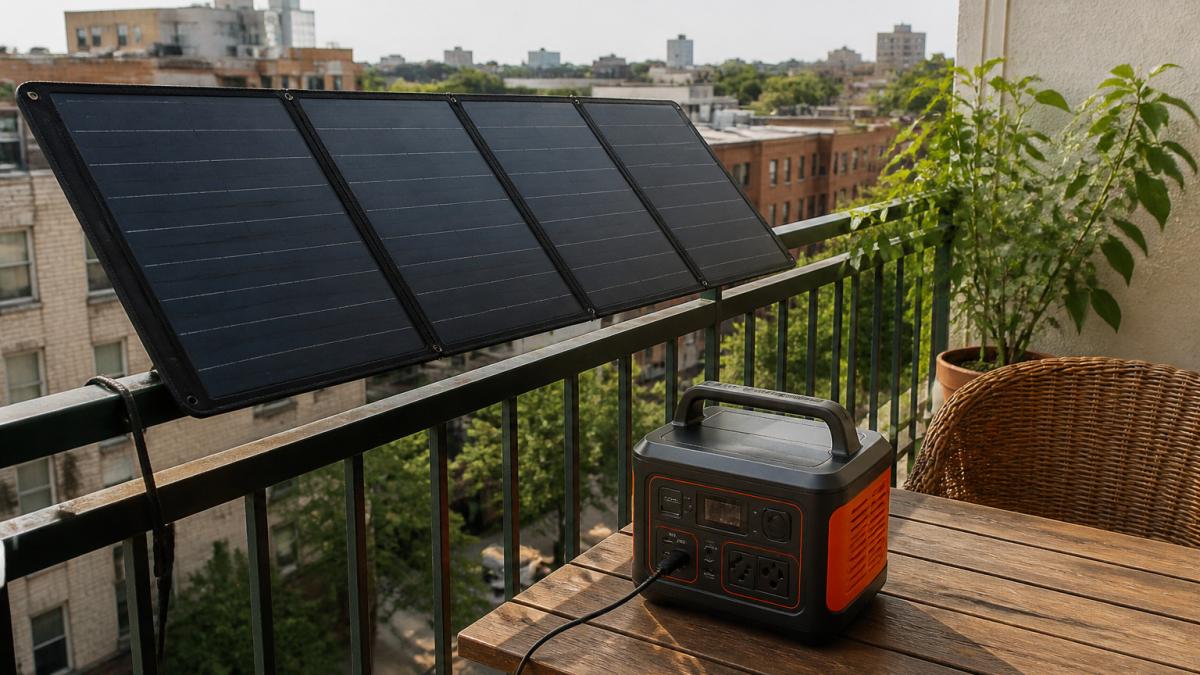
Balcony solar depends on exposure, and railings, neighboring buildings, and overhangs can reduce output. Facing the panel toward the sun is worth doing before setup.
Keep the unit's input limits in mind when planning solar charging. The 2400W model supports adjustable input levels.
What a balcony panel can realistically produce
A panel's rated wattage is measured under standard test conditions, full sun, a specific temperature, and a specific angle, which real balconies rarely deliver. A flat-mounted or partially shaded panel produces meaningfully less than its rating, and shade on even one section can pull down the whole panel's output. Before counting on solar, watch your balcony through a clear day and note how many hours it actually gets direct sun.
Orientation and angle
In the northern hemisphere, panels generally face south for the most sun, with east and west giving morning or afternoon production respectively. A balcony that faces north is a poor solar site in most of the country. Tilt matters too: a panel angled toward the sun at roughly the latitude's angle captures more than one lying flat, but a balcony railing often forces a near-vertical mount. A vertical mount catches low-angle morning and evening sun well and midday sun poorly, which changes when you should expect to charge.
Renter-friendly mounting
Most apartment dwellers cannot drill into the building. Practical options include leaning a foldable panel against the railing at an angle, using a portable panel stand or tripod, or hanging a panel from the railing with straps rated for the load.
Watch out: a panel that is not tied down is a falling-object hazard for anyone below. Secure it to the railing or a stand, and take it in before storms.
Cable routing and weather
Run the cable from the panel to the power station so it does not cross a walkway, hang over the edge, or sit in a puddle. Keep the connection point out of standing water and direct rain, and route the cable through a door or window without pinching it. The power station itself should stay dry and within its operating temperature range, a balcony is not a weatherproof enclosure. Bring the unit inside when it is not charging if rain or extreme heat is forecast.
Shading, soiling, and seasonal variation
Railings, neighboring buildings, trees, and overhangs all cast shade that moves through the day. Dust, pollen, and bird droppings also cut output, so wiping the panel periodically helps. Production falls in winter, when the sun is lower and days are shorter, and on hazy or overcast days. Plan for a wide range between a good summer day and a poor winter one rather than a single number.
Matching panel to unit
Check the unit's solar input limits, voltage range and maximum input wattage, before pairing a panel, because a panel that exceeds the input rating can damage the unit or simply be capped. The 2400W model's adjustable input levels let you adapt charging to the panel and conditions you have. For the 200W compact and 1200W models, confirm the compatible panel on each product page. Solar recharge will generally be slower than a wall outlet.
Choosing Your Balcony Power Station and Getting Started With Already Survival
Start by listing the devices and appliances you need to run, their wattage, and how long you need them to run. For extended backup of critical loads, the 3600W unit is built for that range.
Next, decide how you will recharge. An outlet is simplest. Solar is useful when outlets are unavailable, but it needs a sunny spot and more time.
Store the unit where it stays dry and within its operating temperature range. Browse the full range at Already Survival, and check each product page for current specifications.
Frequently Asked Questions
Can you use a portable power station on an apartment balcony?
Many people use a portable power station on an apartment balcony, but placement matters. Keep the unit out of direct rain, away from doorways and out of reach of children, and make sure it has room for airflow. Check your lease or building rules before using it outdoors or charging solar panels from a balcony, since some buildings restrict equipment on balconies. Store the unit indoors when weather turns bad, and avoid running it in enclosed spaces where heat could build up.
Can a portable power station run a refrigerator?
A portable power station can run a refrigerator for a period, but how long depends on the unit's watt-hour capacity, the fridge's power draw and how often the compressor cycles. Output rating must also cover the fridge's startup surge. Check the appliance label for its running wattage and compare that with the power station's AC output. Because needs vary by household and outage length, plan around your own fridge and check the product labeling for each unit before relying on it.
Can you charge a portable power station with solar panels on a balcony?
Yes, if the power station accepts solar input and the panel is positioned where it gets sun. The 2400W listing in our lineup includes a 200W foldable solar panel, while the 3600W unit accepts solar input with panels sold separately. For other units, whether a panel is included depends on the variant you select. Actual recharge time depends on sunlight, panel angle and weather, so balcony solar charging is usually slower and less predictable than wall charging. Confirm your building permits any panel placement before setting up.
What should you consider when choosing a power station for apartment backup?
Start with the devices you need to run, then compare AC output rating with their wattage and surge needs. Consider watt-hour capacity for how long you need power, the weight and footprint for your space, available output ports, and whether solar input matters to you. Also review your building's rules on equipment and storage. Our lineup ranges from a 200W unit suited to phones and small devices up to a 3600W unit built for larger home backup loads.


