


Last Updated: October 25, 2026
Quick Summary
The best emergency lighting for power outages is a small, layered set of lights covering three jobs: area light for a room, a focused beam for tasks and stairs, and a hands-free light for repairs. Build that set before the first storm warning, because the worst time to compare emergency lighting is in the dark.
- Start with the rooms people occupy after dark, then add one light per person for bedrooms.
- Lanterns light a room, flashlights throw a focused beam, and headlamps keep both hands free.
- Check charging method, battery type, runtime at low output, and power-bank function on rechargeable lights.
- Test every light on a fixed schedule and write the date on tape on the battery door.
- Keep a light within reach of the bed for children and older adults, not in a hallway closet.
Table of Contents
- How to Prepare Lighting for a Power Outage
- Emergency Lights for Home Power Failure: Matching the Type to the Job
- Rechargeable Emergency Lights: What to Check Before You Buy
- Best Lanterns for Power Outages and Area Lighting
- Hands-Free and Portable Lighting: Headlamps and Flashlights
- Safe Battery and Charging Practices for Backup Lighting
- Lighting for Children, Older Adults, and People With Disabilities
- Stock Your Backup Lighting Kit
- Frequently Asked Questions
How to Prepare Lighting for a Power Outage
The best emergency lighting for power outages is not one product. It is a small, layered set of lights that covers three jobs: area light for a room, a focused beam for tasks and stairs, and a hands-free light for repairs. At Already Survival, we tell customers to plan that set before the first storm warning, because the worst time to compare emergency lighting is in the dark.
A power failure rarely arrives alone. It comes with a downed line, a flooded road, or a tree on the roof, and every decision gets harder once the house goes black. Below, we break down which light types fit which rooms, what to check on rechargeable models, and how to store a backup lighting kit that still works two years from now.
Build a Plan by Room and Household Size
Start with the rooms people actually occupy after dark, then add one light per person for the rooms they sleep in. A workable household plan looks like this:
Room or Zone |
Light Type |
Why It Fits |
|---|---|---|
Kitchen and living area |
Lantern with area lighting |
Lights a whole table or counter |
Bedrooms |
Small lantern or night-light |
Keeps the floor visible without glare |
Hallways and stairs |
Battery-backup plug-in light or battery motion sensor light |
Activates automatically when someone walks past |
Garage, attic, utility closet |
Headlamp |
Frees both hands for valves and breakers |
Vehicles and go bags |
Compact flashlight |
Portable and easy to store |
Household size changes the count, not the categories. A couple in an apartment may need three lights. A family of five in a two-story house needs a light at every stair landing plus one per bedroom. Older adults and young children need a light within reach of the bed, not in a hallway closet.
A room-by-room lighting plan works best as one piece of a larger household plan, so it helps to see how to create an emergency response plan for your household and slot lighting into it.
Test and Store Your Lights Before You Need Them
A light that has sat untouched in a drawer for a year is a guess, not a backup. Test every light on a fixed schedule and write the date on a strip of tape on the battery door.
- Switch on every light and confirm full output
- Charge rechargeable lights to full, then unplug
- Check that spare batteries match the device
- Confirm chargers and cables are stored with the light, not borrowed for other devices
- Re-test after any long storage period or seasonal storm forecast
Store lights where you will reach for them in the dark: a kitchen drawer, a nightstand, a shelf by the garage door. A lantern buried behind holiday decorations is not part of your plan.
Emergency Lights for Home Power Failure: Matching the Type to the Job
Emergency lights for home power failure fall into five working categories, and each one solves a different problem. Matching the type to the job matters more than buying the brightest option on the shelf.
- Lanterns spread light across a room and sit stable on a table.
- Flashlights throw a focused beam for distance and detail work.
- Headlamps keep both hands free.
- Battery-backup night-lights and plug-in lights (models that switch on when the power fails) handle hallways and bathrooms.
- String lights and stick lights add low-level light along a path or under a cabinet.
Brightness is not the same as usefulness. A very bright beam pointed at a wall bounces glare back at you, while a modest area light at eye level makes a room feel normal. Adjustable brightness settings let one light serve both a dinner table and a midnight trip to the bathroom.
Runtime and battery life decide how the night actually goes. A light rated for a handful of hours on high may run much longer on a low setting, so check the low-output figure, not just the headline number.
Rechargeable Emergency Lights: What to Check Before You Buy
Rechargeable emergency lights only earn their place if they are charged when you need them. Before buying, check four things: charging method, battery type, runtime at low output, and whether the light can double as a power source.
USB charging is the most flexible option because it works from a wall adapter, a car charger, or a battery bank.
Battery type affects storage. Lithium-ion cells hold a charge well between uses, while lights that take standard AA or AAA batteries let you swap in fresh cells without waiting for a recharge.
Watch out: a rechargeable light stored at zero charge for months can lose capacity, so top it up on a schedule rather than leaving it drained in a drawer.
Best Lanterns for Power Outages and Area Lighting
Lanterns do the job no flashlight can: they light a room instead of a spot.
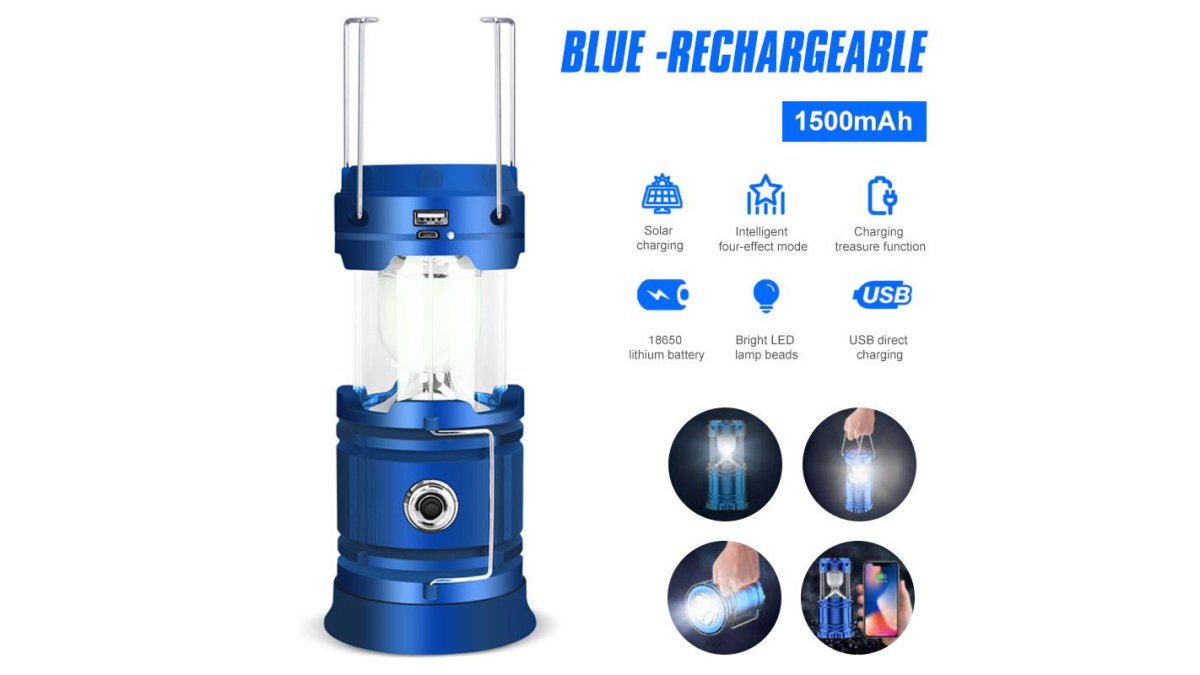
The Solar LED Camping Lantern is a practical example of the category.
Solar LED Camping Lantern – USB Rechargeable Waterproof Emergency Light →

For a softer, lower-cost option, the Portable Solar Flame Lantern uses solar power and takes three AA batteries, which are not included. It is a metal-bodied retractable light, so it packs flat and runs on cells you can replace.

Hands-Free and Portable Lighting: Headlamps and Flashlights
Headlamps and flashlights cover the jobs that need a beam rather than a glow. A headlamp is the better choice for anything involving two hands: shutting off a gas valve, checking a breaker panel, or changing a tire on a roadside emergency.
The Rechargeable LED Headlamp is a good illustration of what to look for. Check its listing for maximum output, beam coverage, charging type, and headband fit before buying.

For a handheld option, the Portable Rechargeable LED Flashlight uses an aluminum alloy body, a built-in 1800mAh battery, and Type-C USB charging. Its listing describes a uniform, bright beam with a larger lighting area, which suits walking a dog, checking a yard, or lighting a hallway.
The Liteband® Premium Tactical Flashlight features a LUMINUS SST20 LED bulb that delivers 1200 Lumens of powerful lighting and a 5 mode Tail Cap Switch for ultimate versatility: High, Med, Low, Pulse and SOS. Its listing states a 2600 mAh Lithium ion rechargeable battery, giving up to 20 hours of light time with USB-C charging. It comes with a nylon holster and suits a vehicle kit or a go bag where a durable handheld light earns its space.
Safe Battery and Charging Practices for Backup Lighting
Battery safety is the part of backup lighting that gets skipped, and it is the part that matters most. Follow the manufacturer's instructions on the label and in the product listing, and treat every battery as a device that needs watching.
- Charge rechargeable lights on a non-flammable surface, away from bedding and curtains
- Do not charge a light that shows swelling, a damaged port, or a burning smell
- Match replacement batteries to the type and size the device specifies
- Store spare cells in original packaging or a battery case, away from metal objects
- Keep lithium batteries out of reach of small children
- Follow local guidance for disposing of swollen or expired batteries
For USB charging during an outage, a portable power station keeps phones and lights running when outlets are dead. The 200W Portable Power Station lists a 172.8Wh battery with an AC outlet, DC port, and USB QC3.0, and is described as solar compatible. For a longer outage, the larger 1200W Portable Power Station lists four AC outlets and six USB ports. Anyone who relies on powered medical equipment should confirm compatibility and runtime with the device maker before depending on a power station.
Lighting for Children, Older Adults, and People With Disabilities
Lighting needs change with the people in the house, and a plan built for a healthy adult may not serve a child or an older parent. Adjust the plan to the person, not the room.
For children, keep a small light within reach of the bed and show them how to switch it on before they ever need it.
For older adults, prioritize steady light at floor level along the path to the bathroom, plus a light that does not require bending or reaching.
For people with disabilities or limited mobility, hands-free lighting matters more than brightness. A headlamp or a light that clips to a wheelchair or walker keeps the beam pointed where the person is working.
Stock Your Backup Lighting Kit
A backup lighting kit should be assembled once and checked on a schedule, so nobody is searching for a working light during a storm. Ours would include:
- One lantern per main living area
- One headlamp per adult
- One compact flashlight per vehicle and go bag
- A battery-backup plug-in light or battery motion sensor light for each hallway
- Spare batteries in the sizes your lights use
- A battery bank or power station for USB charging
- Charging cables stored with the lights
Lighting is one part of a broader set of emergency supplies, and it works best when it is packed alongside water, food, and first aid. Our guide on how to build a 72 hour kit for beginners shows how to assemble those pieces step by step so the lighting kit fits into a complete household plan.
The real test of a lighting plan is the night the power actually fails. Build the layers now, test them on a schedule, and store them where you can reach them in the dark. Already Survival carries lanterns, headlamps, flashlights, and portable power stations selected for practical home and outdoor use, with free shipping on all U.S. orders, secure encrypted checkout, and a 30-day return policy for unused items.
Frequently Asked Questions
What are the best emergency lights for home when the power goes out?
There is no single best light for every home. Most households do well with a mix: a rechargeable lantern for area lighting in the kitchen or living room, a headlamp or flashlight for hands-free tasks and stairs, and a small night-light for hallways and bathrooms. Match the count and type to your household size, the rooms you use most, and how long outages typically last in your area.
Are lanterns or flashlights better for a power outage?
They solve different problems. Lanterns spread light across a room, which suits meals, homework, and gathering everyone in one place. Flashlights throw a focused beam for checking a breaker panel, walking to the car, or inspecting damage. A practical setup includes at least one of each, plus a headlamp if you need both hands free. Rechargeable emergency lights with adjustable brightness let you dim a lantern to stretch runtime overnight.
How should I choose emergency lighting for different rooms?
Think about what each room is used for during an outage. Kitchens and living areas need area lighting such as a lantern. Hallways, stairways, and bathrooms benefit from a battery-backup plug-in night-light or battery-powered motion-sensor light that activates automatically; standard plug-in night-lights go dark when the power fails. Bedrooms need a light within reach of the bed. For children and older adults, keep a dedicated light on a nightstand and check that switches are easy to find in the dark.
How can I keep rechargeable emergency lights ready for an outage?
Charge rechargeable lights fully and check them on a regular schedule, such as the first weekend of each month. Store them in the same known spot so nobody has to search in the dark. Keep a USB power bank or portable power station charged for recharging lights during a long outage, and note that some lanterns also accept solar charging. Follow the manufacturer's guidance on battery care and avoid storing lights where they get very hot or wet.


