


Table of Contents
- Why Every Family Needs a Communication Plan Before the Next Outage
- What to Gather Before You Fill Out Your Family Emergency Plan Template
- Step 1: Build Your Emergency Contact List Template
- Step 2: Choose an Out-of-Area Emergency Contact
- Step 3: Pick Meeting Places and Reunification Steps
- Step 4: Make a Family Emergency Communication Card
- Step 5: Plan for Separated Family Members and Power Outages
- Practice, Review, and Update Your Plan
- Frequently Asked Questions
Last Updated: October 18, 2026
Why Every Family Needs a Communication Plan Before the Next Outage
An emergency communication plan template for families is a written record of who each household member calls, where everyone meets, and how you reconnect when phone networks fail. The Ready.gov family communication planning guidance treats this as one of the first steps in household preparedness, because chaos during an emergency usually comes from uncertainty, not danger.
Here is the part most guides get wrong. They hand you a blank form and stop. A form is not a plan. A plan is a form your family has discussed, practiced, and updated.
Below, we walk through each step of building a family emergency plan template you can actually use, from gathering household information to testing the whole thing on a Sunday afternoon.
What to Gather Before You Fill Out Your Family Emergency Plan Template
Start with information, not forms. A family emergency plan template only works if the details inside it are current.
Collect these items for every household member:
- Full legal names and nicknames
- Mobile numbers and work or school numbers
- Home address written out in full
Write this down on paper first. Many families find that half the numbers in their phones are outdated or saved under a nickname nobody else recognizes.
Step 1: Build Your Emergency Contact List Template
An emergency contact list template is a single page listing every person your household might need to reach, with names, relationships, and phone numbers.
Structure it in three tiers:
- Household members: everyone who lives under your roof, with mobile and work numbers.
- Local contacts: a trusted neighbor, nearby relative, school office, and workplace.
- Out-of-area contacts: one or two people outside your region, covered in the next step.
Include a line for each contact's preferred method. Some people answer texts quickly and never check voicemail.
Keep one printed copy in your go bag and one on the refrigerator. A phone contact list is useful until the battery dies.
Step 2: Choose an Out-of-Area Emergency Contact
An out-of-area emergency contact is a person outside your local area who serves as the relay point when local lines are jammed. Long-distance calls often connect when local networks are overloaded, which is why emergency managers recommend this setup.
Pick someone your whole household knows and trusts. Then do three things:
- Ask them first. Confirm they are willing to be the relay.
- Give them a copy of your contact list.
- Agree on a check-in window, such as "text within 12 hours if you can."
School-age children should memorize this person's name and number. Write it on a card for younger kids.
Step 3: Pick Meeting Places and Reunification Steps
Reunification is the process of getting separated household members back together at a known location. Two meeting places make this manageable.
Neighborhood meeting place: a spot within walking distance, like a specific neighbor's front porch or the end of the block.
Out-of-area meeting place: a landmark outside your immediate neighborhood, such as a relative's home or a community building. Use it when you cannot return home at all.
Walk both routes with your family. Show younger children the neighborhood spot in person. Then write simple reunification steps on your template:
Follow evacuation or shelter-in-place instructions first. Use your agreed meeting place only when the location and route are safe. Check in with your out-of-area contact as soon as safely possible. Children at school or childcare should follow that facility’s reunification procedure and remain with responsible staff until released to an authorized adult. If the first meeting place is unsafe or inaccessible, use your agreed backup when safe to do so. Do not return home just to leave a note.
Step 4: Make a Family Emergency Communication Card
A family emergency communication card is a wallet-sized card with the essentials: out-of-area contact, two meeting places, and each household member's name.
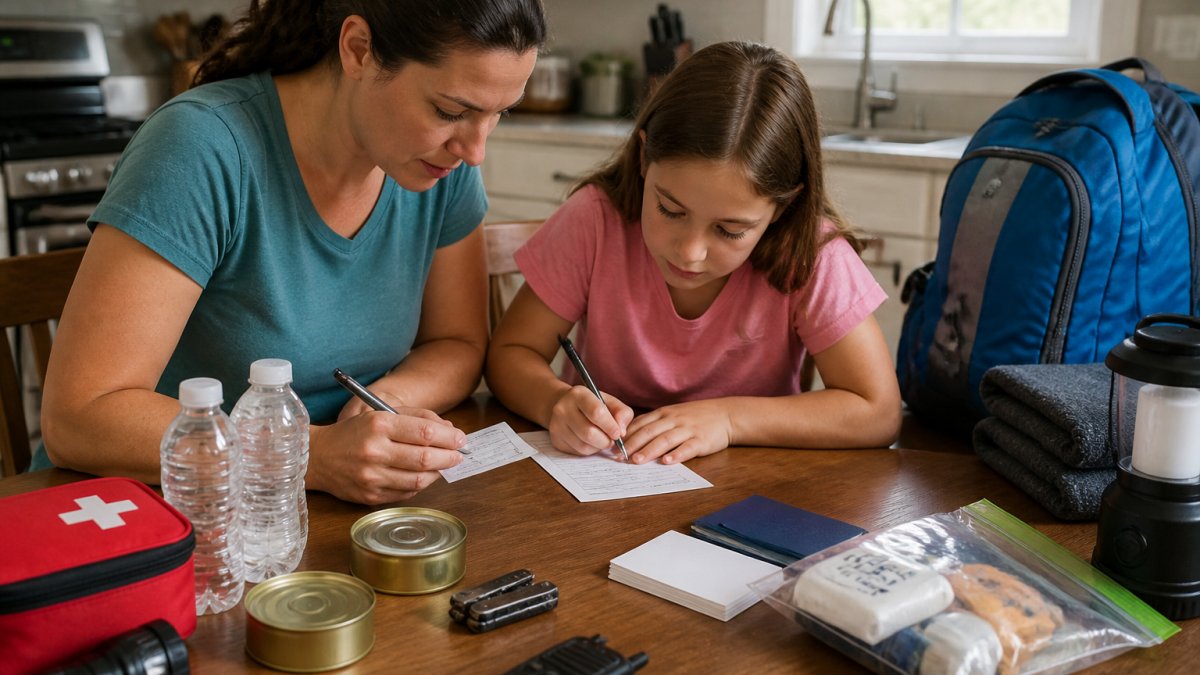
Keep the card small and laminate it if you can. Skip full medical details on the card itself.
Step 5: Plan for Separated Family Members and Power Outages
Communication failure is the norm in a real emergency, so plan for it directly. This is where most family emergency plan templates stop short: they list phone numbers but never explain what happens when the network is overloaded, the power is out, or a family member cannot use a phone at all.
The default check-in rule
When family members are separated, agree on a default: everyone checks in with the out-of-area contact, not with each other. That single rule prevents a flood of calls that will not connect anyway. Write the rule on the template in plain language a child can read: "If we are apart, text [out-of-area contact]. Do not keep calling Mom and Dad."
What actually happens to calls and texts
During an emergency, network congestion, damaged equipment, or power loss can interrupt calls and messages. Text messages may get through when calls cannot, but delivery can be delayed or fail. Send a short message with your location, condition, and next planned check-in time. A missing reply does not necessarily mean someone is in danger.
Add these mechanics to your plan:
- Agree on a text-first rule. Try one text, then wait. Repeated retries drain the battery and clog the queue.
- Enable and test Wi-Fi calling in advance if your phone and carrier support it. It requires a working internet connection and power for the network equipment, so it may also be unavailable during an outage.
- Save offline maps. Download your local area and the route to your out-of-area meeting place in a maps app so directions work without a signal.
Power-outage contingencies
For power outages, add these to your template:
- A printed copy of the contact list, since phones may die
- A battery-powered or hand-crank radio for official updates
- A charging plan, such as a portable power station kept topped up, plus car chargers as a fallback
Age- and ability-specific notes
The same template does not fit every household. Add a short section for each person who needs extra support:
- Infants and toddlers: note who is responsible for carrying the child, what supplies travel with them, and which caregiver is the primary contact. A child too young to memorize a number still needs a named adult assigned to them in writing.
- School-age children: write the out-of-area contact's name and number on a card in the backpack, and confirm the school's own reunification procedure so your plan matches theirs.
- Older adults: note mobility equipment, whether they can evacuate stairs, and any assistive devices. If a family member uses a communication device or has hearing or vision needs, write down how they receive alerts (for example, a vibrating alert or a large-print list).
Families with infants, older adults, or members with disabilities should also note specific needs such as medication refrigeration or mobility equipment. For prescription medications, follow the product labeling and guidance from a healthcare professional or pharmacist rather than stocking to a fixed rule. Our Family Blackout Kit includes a radio, lantern, hand rechargeable flashlights, and other lighting and communication items for exactly this situation.

Practice, Review, and Update Your Plan
A communication plan template is only as good as its last update. Set a review date twice a year, ideally when you change smoke alarm batteries, and treat the review as a short family meeting rather than a chore.
A completed example to copy from
Most families stall because a blank form is intimidating. Here is a filled-in example of what a finished page looks like. Adapt the details to your household; do not copy the names.
Field |
Example entry |
|---|---|
Household members |
Alex (parent, mobile), Sam (parent, mobile), Riley (age 9, no phone) |
Local contact |
Neighbor across the street, name and mobile |
Out-of-area contact |
Aunt in another region, name and mobile |
Neighborhood meeting place |
The corner mailbox at the end of the block |
Out-of-area meeting place |
Relative's home two towns over |
School contact |
Front office number and the school's reunification procedure |
Check-in rule |
Text the out-of-area contact first; wait, do not redial |
Medical/accessibility notes |
Allergy noted on master list; mobility aid stored by the door |
Make it printable and editable
Keep two versions: a printed master copy on the refrigerator and in the go bag, and an editable digital copy you can update without reprinting everything. When you update the digital version, print a fresh copy the same day so the two never drift apart. Store the digital file somewhere you can reach without a signal, such as a downloaded file on a charged device, not only in a cloud account that needs internet.
Accessible and multilingual formats
Every household member should be able to use the plan, not just the adults who wrote it. Consider:
- Large print for older adults or anyone with low vision
- Easy-read wording with short sentences and pictures for younger children
- A translated copy if any household member is more comfortable in another language
Handle sensitive information carefully
A plan holds addresses, phone numbers, and medical details. Keep the full master list at home and give out only the minimum needed to reconnect. Do not post the plan publicly, do not leave it visible in a car, and do not put birthdates, Social Security numbers, or full medical histories on a card a child carries to school. If a card is lost, that information is exposed.
Run a short drill
Have each family member text the out-of-area contact from a different room, then gather at the neighborhood meeting place. Time it. Kids who have done it once will do it faster the second time.
Update the plan when anything changes: a new phone number, a move, a new school, or a new caregiver. Our Children's Survival Kit pairs well with this step, since it gives younger family members their own supplies to keep with a printed card.

Task |
How Often |
Who |
|---|---|---|
Verify phone numbers |
Every 6 months |
Adults |
Practice meeting place drill |
Every 6 months |
Whole household |
Test offline/printed version |
Every 6 months |
Whole household |
Update school and work contacts |
Start of school year |
Parents |
Replace printed copies |
When anything changes |
Adults |
Check go bag supplies |
Every 6 months |
Adults |
Frequently Asked Questions
What should be included in an emergency communication plan?
A complete plan includes household member names and phone numbers, an emergency contact list template with school, childcare, caregiver, and workplace contacts, one out-of-area emergency contact, a neighborhood meeting place, an out-of-area meeting place, and a family emergency communication card kept in wallets and bags. Add medical information that matters in a crisis, plus a printed copy stored offline. Review it together as a household and update it whenever numbers, schools, or addresses change.
What should family members do if phone calls do not go through?
Try a text message first, since texts often get through when voice calls fail on a congested network. If that does not work, wait a short set period and try again rather than calling repeatedly. Then follow the plan: check in with your out-of-area emergency contact, who can relay messages between separated family members. If you cannot reach anyone, follow your agreed plan and official instructions. Travel to a meeting place only when it is safe; children at school or childcare should follow the facility’s reunification procedure. Do not return to an unsafe home to leave a note.
Who should be the out-of-area contact in a family emergency plan?
Pick someone outside your immediate area, ideally in another region, who is likely to be unaffected by the same disaster. They should be willing to answer calls and relay messages between household members. Give that person a copy of your contact list and confirm they understand the role. Choose a backup as well, since the first contact may be unavailable. Both adults and children should memorize that person's phone number.
How often should a family review its emergency communication plan?
Review the plan at least twice a year, and again any time a phone number, school, workplace, or address changes. Use the review to check that printed copies are current, that communication cards still fit in wallets and bags, and that children can recite the out-of-area contact number. A short household practice, such as a text check-in drill, shows you which steps need fixing before a real emergency tests them.
Emergencies rarely give you time to look things up. The families who reconnect fastest are the ones who wrote it down, talked it through, and practiced once. Already Survival carries the practical gear that supports that plan, from go bags to lighting and power backups, with free shipping and a 30-day return policy on unused items. Search our site to find the supplies that fit your household, then sit down with your family and fill out the template together.


