


Table of Contents
- What to Look for in Portable Power for Emergencies
- Portable Power Station Capacity Explained
- Solar Generator vs Portable Power Station: Which Fits Your Needs
- How to Maintain Lithium Batteries for Emergencies
- Emergency Power Backup for Home Appliances
- Portable Power Options for Different Emergency Scenarios
- Recharge Time and Solar Compatibility
- Frequently Asked Questions
Last Updated: September 24, 2026
What to Look for in Portable Power for Emergencies
When the power goes out, you need equipment that won't let you down. Choosing the right portable power for emergencies means understanding what actually matters: how much energy you need, how fast you can recharge it, and whether it fits your space and budget.

Choosing portable power for an emergency involves balancing battery capacity, power output, recharge options, portability, and the equipment you expect to operate. A larger battery can provide more stored energy, while sufficient output capacity is necessary to operate higher-powered devices. Recharge time and available charging methods can also become important during an extended outage.
Key features to consider include a battery management system, available output types such as AC, DC, and USB, compatible charging options, and the manufacturer's specified operating and storage temperature ranges.
Portable Power Station Capacity Explained
Portable power stations are measured in watt-hours (Wh), total energy storage. A 1000Wh battery holds twice as much energy as a 500Wh battery, but watt-hours alone don't tell you whether a unit will run your devices.

Understanding Watt-Hours and Continuous Output
Watt-hours (Wh) measure the amount of energy a power station can store, while watts (W) measure how much power it can deliver at a given time. A power station may have enough stored energy for a device but still be unable to operate it if the device requires more power than the station's rated continuous or surge output.
Continuous output refers to the amount of power a station is designed to supply during normal operation. Some devices can briefly require additional power when starting, so it is important to compare both continuous and surge requirements with the power station manufacturer's specifications.
AC outlets deliver 120V for appliances, DC outlets (12V) and USB ports deliver lower voltage for devices. Home emergency units should include all three output types.
Calculating Real-World Appliance Runtime
A basic runtime estimate can be made by dividing a power station's watt-hour capacity by the wattage of the device being powered. However, this is only a rough estimate. Actual runtime can vary because of inverter losses, battery condition, temperature, device cycling, startup power requirements, and other factors.
Capacity and output also need to be considered separately. A power station must have enough continuous and surge output to operate the connected device, while its stored battery capacity determines approximately how long that device can operate. Always compare the device's power requirements with the power station manufacturer's specifications.
Solar Generator vs Portable Power Station: Which Fits Your Needs
"Solar generator" is marketing language for a portable power station compatible with solar panels. The difference is whether panels are included or sold separately.

Portable power stations may support several charging methods, including household outlets, vehicle charging, and compatible solar panels. Solar input capabilities vary considerably by model, so check the manufacturer's specifications for supported panel types, connectors, input limits, and charging requirements.
Solar panels can provide another way to recharge compatible power stations when grid power is unavailable. Actual solar output depends on factors such as available sunlight, weather conditions, panel placement, temperature, and the specifications of both the panel and power station.
Whether solar panels make sense depends on how you plan to use the power station. They may be particularly useful during extended outages, camping trips, or off-grid situations where access to conventional charging is limited.
3600W Portable Power Station – 3840Wh →
How to Maintain Lithium Batteries for Emergencies
Lithium iron phosphate (LiFePO4) batteries are commonly used in portable power stations. Like other rechargeable batteries, proper storage and maintenance can help preserve their performance over time.
Follow the manufacturer's instructions for recommended storage charge level, recharge frequency, and operating temperature. These recommendations can vary by model and battery system.
Store the power station in an appropriate location according to the manufacturer's guidance, and periodically check its condition and charge level so it is ready when needed.
Emergency Power Backup for Home Appliances
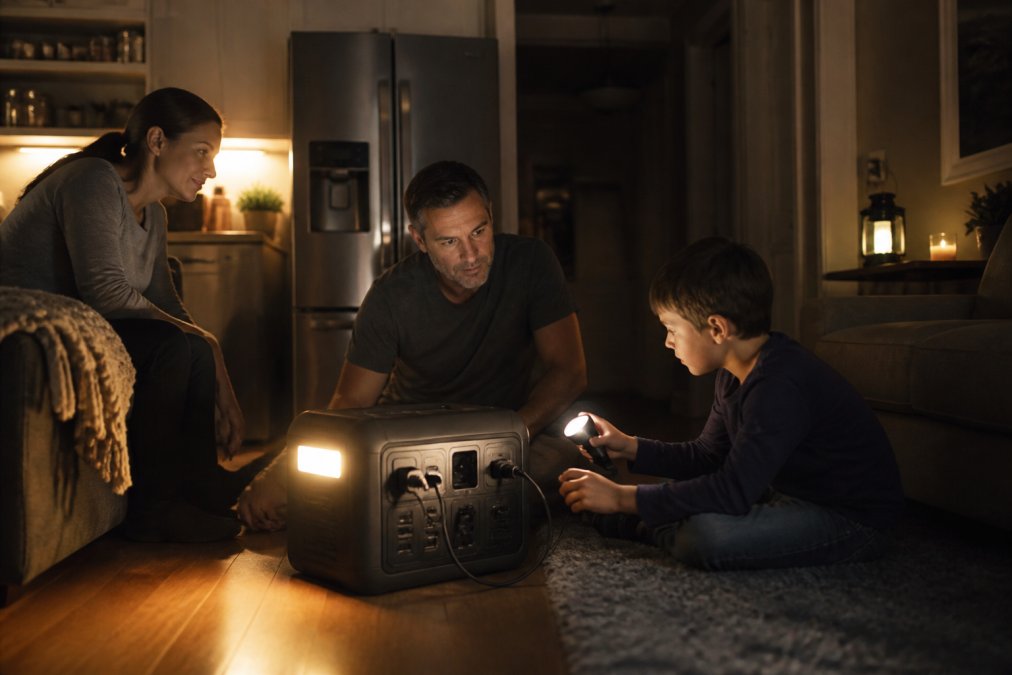
Refrigerators and other household appliances can vary significantly in their power requirements. When planning emergency backup power, check the appliance label or manufacturer's documentation for its operating and startup power requirements. Compare those figures with the power station's rated output and capacity, keeping in mind that actual runtime can vary depending on appliance use, battery conditions, and other factors.
Portable Power Options for Different Emergency Scenarios
Not every emergency needs the same equipment. A weekend camping trip, a multi-day home outage, and a roadside breakdown all demand different capacity and portability trade-offs.
High-Capacity Units for Extended Home Backup
Higher-capacity portable power stations can be useful when you want to operate multiple devices or higher-powered equipment during an outage, at a campsite, in an RV, or in other off-grid situations. When comparing larger units, consider battery capacity, continuous and surge output, available ports, expansion options, recharge methods, and any backup-power features listed by the manufacturer.
Mid-Range Systems for Flexible Use
The 2400W Portable Power Station with 2160Wh capacity and included 200W solar panel offers a balance of capacity and portability for home backup, RV trips, camping, and other situations where access to power may be limited. When considering a system like this, compare the equipment you plan to operate with the station's rated output and capacity, available charging methods, and manufacturer specifications.
Compact Stations for Portability and Travel
The 200W Portable Power Station with 172.8Wh capacity is suitable for camping and hiking, road trips and van life, home emergency backup for small devices, and as a thoughtful gift for preppers and outdoor enthusiasts. It is compact and lightweight, making it easy to pack for camping, travel, or your car.
Jump Starters and Multi-Function Power Banks
Jump starters are designed to provide high peak current for starting compatible vehicle batteries. Some models also include additional features such as LED flashlights and power-bank functionality. When choosing a jump starter, check the manufacturer's vehicle compatibility, operating instructions, and listed features to make sure it fits your needs.
Recharge Time and Solar Compatibility
Recharge time is an important consideration when choosing portable power for extended outages. Charging speed varies by model, battery capacity, charging method, supported input power, temperature, and other conditions. Check the manufacturer's specifications for estimated charging times using wall, vehicle, or compatible solar charging.
Unit |
Capacity |
Continuous Output |
||
|---|---|---|---|---|
3600W Portable Power Station |
3840Wh |
3600W |
||
2400W Portable Power Station |
2160Wh |
2400W |
||
1200W Portable Power Station |
968Wh |
1200W |
||
200W Portable Power Station |
172.8Wh |
200W |
||
4000A Jump Starter |
88.8Wh |
Vehicle starting |
Frequently Asked Questions
What features should I prioritize when choosing portable power for emergencies?
Focus on battery capacity, continuous and surge output, recharge options, and the types of devices you plan to power. For home emergencies, capacity and available AC outlets may be important, while portability and weight may matter more for camping or travel. Also consider battery chemistry and the number and type of available connections, such as AC outlets, USB ports, and DC outputs. Always compare the power station's specifications with the requirements of the equipment you intend to use.
How do I calculate how long a portable power station will run my appliances?
A basic runtime estimate can be made by comparing the power station's watt-hour capacity with the power requirements of the equipment you want to operate. Actual runtime can vary because of inverter losses, battery condition, temperature, device cycling, and startup power requirements. Check the appliance label or manual for its power requirements and compare them with the power station manufacturer's rated capacity, continuous output, surge output, and estimated runtime information.
What's the difference between a solar generator and a portable power station?
The terms are often used interchangeably. A portable power station stores electrical energy in a rechargeable battery and may support charging from household outlets, vehicle charging, compatible solar panels, or other sources depending on the model. The term “solar generator” is commonly used for a portable power station designed to work with solar panels, sometimes with the panels included and sometimes sold separately. Check the manufacturer's specifications for compatible solar panels, connectors, and input requirements.
How should I store and maintain a portable power station for long-term emergency readiness?
Store your portable power station according to the manufacturer's instructions and protect it from excessive heat, moisture, direct sunlight, and other conditions the manufacturer advises against. Check the manual for recommended storage charge levels, recharge frequency, and operating temperatures. Periodically inspect the unit and verify its charge level and operation so it is ready when needed.
Can I run medical equipment or a home transfer switch with a portable power station?
Whether a portable power station can support medical equipment or a home backup system depends on the specific equipment and power station involved. For medical devices, check the device manufacturer's power requirements and backup-power recommendations, and consult a qualified healthcare or equipment professional when necessary. For connection to household electrical circuits or a transfer switch, follow the power station manufacturer's instructions and consult a qualified electrician to determine whether the equipment and installation are compatible and safe.


