


Table of Contents
- How Portable Water Filters Are Evaluated for Camping and Emergencies
- Types of Portable Water Treatment Systems
- Water Filter vs Water Purifier for Camping
- How to Purify Water for Survival
- Cold Weather Performance and Freezing Risks
- Chemical Contamination vs Biological Filtration
- Long-Term Storage and Shelf-Life Maintenance
- DIY Emergency Water Filtration Alternatives
- Frequently Asked Questions
Last Updated: September 29, 2026
How Portable Water Filters Are Evaluated for Camping and Emergencies
A portable water filter is a compact device that removes pathogens and particulates from backcountry or emergency water sources. Choosing one comes down to two numbers, micron rating and flow rate, plus one honest question: what is actually in your water source?
Micron Ratings and Pathogen Removal
A micron is one millionth of a meter. Micron rating describes the size of the openings in a filter's media: the lower the number, the finer the filtration and the more resistance water meets.
- Protozoa such as Cryptosporidium and Giardia are the largest common pathogens. Giardia cysts are roughly 8-12 microns; Cryptosporidium oocysts are around 4-6 microns. Filters rated at 1 micron absolute or finer address these reliably.
- Bacteria such as E. coli, Salmonella, and Campylobacter are smaller, typically in the 0.2-2 micron range. A 0.2 micron absolute rating is the common threshold cited for reliable bacterial removal.
- Viruses such as norovirus, rotavirus, and hepatitis A are far smaller, often measured in nanometers rather than microns, and are not reliably removed by mechanical filtration alone.
Flow Rate and Field Maintenance
Flow rate is measured in liters per minute, and it is the spec you feel every time you refill. A gravity-fed system can take many minutes per liter but requires no effort; a squeeze filter is faster per bottle but demands hand strength; pump filters sit in between.
Matching the Filter to the Source and the Group
Specs only matter in context: a filter perfect for one hiker on a clear alpine creek may be wrong for a family of four pulling from a silty reservoir after a storm.
- Source clarity: Clear water is easy on any filter. Turbid water demands a pre-filter and more frequent backflushing.
- Group size: One person can manage a squeeze filter. Four or more people usually do better with a gravity system that filters while they set up camp.
- Trip length: A short weekend trip tolerates a small cartridge. A multi-week trip or a long-term emergency kit needs a filter with a serviceable cartridge and a maintenance routine.
- Threat profile: Remote wilderness sources are usually a biological problem. Sources near agriculture, industry, or failed sanitation may also be a chemical problem, which is a different conversation entirely.
Types of Portable Water Treatment Systems
Portable water treatment systems split into a few practical categories, each suited to a different trip. The right choice depends on how much water you need, how many people you supply, how much weight you will carry, and how much effort you want per liter.
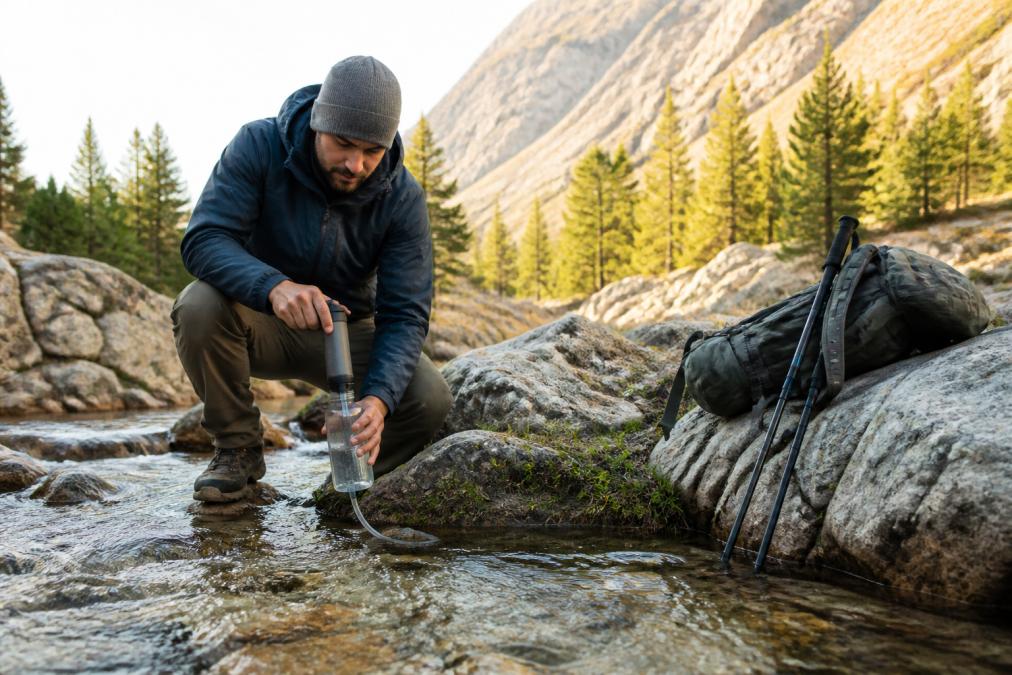
Gravity-Fed, Squeeze, and Pump Filters
- Gravity-fed systems hang from a tree or rock and filter by weight alone. Water moves through the membrane slowly, so the system filters while you do other things. Best for base camps, group use, and any situation where you can wait. The trade-off is that you need a clean hanging point and a container to catch the output.
- Squeeze filters attach to a bottle or pouch and are pushed by hand. Best for solo hikers and backpackers who want speed and low weight. The trade-off is hand fatigue on long trips and a lower total volume per session.
- Pump filters push water through with a handle. Best for murky sources and larger volumes where you want control over the intake. The trade-off is weight and moving parts that can wear or clog.
Each category has a different failure mode: gravity systems when the bag or tubing leaks, squeeze filters when the pouch splits or the membrane clogs, pump filters when seals dry out or the intake clogs. Knowing the failure mode tells you what spare parts to carry.
Ultralight and Backpacking Options
For ultralight setups, backpacking filters prioritize grams over convenience. A small hollow fiber membrane unit with a squeeze pouch can cover one person for days. The trade-off is effort and a lower flow rate per minute.
Chemical Treatment, UV, and Boiling as Complements
Filtration is not the only portable option, and the strongest plans combine methods.
- Chemical treatment (tablets or drops) is light, has no moving parts, and addresses viruses that mechanical filters miss. It works slowly and can leave a taste. It also works best on clear water, because sediment can shield pathogens from the chemical.
- UV treatment uses light to disrupt pathogen DNA. It is fast and leaves no taste, but it requires clear water and a power source, which makes it a poor fit for long off-grid emergencies.
- Boiling is the most reliable single method for killing pathogens when fuel is available. It does nothing for chemical contamination and requires cooling time before storage.
Matching the System to the Scenario
- Solo weekend backpacking: A squeeze filter or a small gravity setup is usually enough.
- Group base camp: A gravity system sized to the group, plus a chemical backup, covers most needs.
- Car camping or household emergency kit: A larger gravity or pump system, plus boiling capability, gives redundancy without much weight penalty.
- International travel or disaster zones: A purifier or a filter-plus-chemical combination is the safer call, because viral contamination is a real concern.
Water Filter vs Water Purifier for Camping
A water filter removes pathogens and particles by size. A water purifier goes further and also addresses viruses, usually through chemical treatment, UV, or a combination of methods. This is the water filter vs water purifier for camping question that trips up many buyers.
- Filter: protozoa and bacteria. Fine for most clear backcountry sources.
- Purifier: protozoa, bacteria, and viruses. Preferred where water may be contaminated by human waste or runoff.
A filter alone does not address viruses. In situations where human waste may have entered the water, pair filtration with a chemical treatment or use a purifier. Skipping this step is the most common mistake in emergency water planning.
How to Purify Water for Survival
Knowing how to purify water for survival means having more than one method available. No single tool covers every scenario, and redundancy keeps a plan working when gear fails or conditions change.
- Filter or purify first to remove pathogens and turbidity.
- Boil as a backup. Bring clear water to a rolling boil for at least 1 minute. At elevations above 6,500 feet, boil for 3 minutes.Chemically treat with approved tablets or drops when fuel and filters are unavailable.
- Store safely in clean, dedicated containers to avoid recontamination.
Cold Weather Performance and Freezing Risks
Freezing is the quiet killer of water filters. Water left inside a hollow fiber membrane can expand, damage the fibers, and compromise filter integrity without any visible sign. A filter that looks fine can be passing contaminated water after a hard freeze.
- Sleep with your filter in your bag, not in an outside pocket.
- Drain and backflush before cold nights.
- Store cartridges dry when not in use.
Chemical Contamination vs Biological Filtration
Filters are built for biological threats: protozoa, bacteria, and the particulates that carry them. They are not designed to remove dissolved chemicals such as pesticides, heavy metals, or industrial runoff, a different problem requiring different media, often activated carbon or specialized treatment.
Long-Term Storage and Shelf-Life Maintenance
Stored filters and treatment supplies need attention, not just shelf space. Cartridge lifespan varies by use and source quality, and stored gear can degrade quietly over time.
Situation |
What to Check |
Practical Action |
|---|---|---|
Filter stored for months |
Cartridge condition, seals |
Inspect and test before relying on it |
Chemical tablets |
Expiration date |
Replace expired supplies |
Frozen filter |
Membrane integrity |
Verify or replace |
Frequent silty water |
Clogging and flow |
Backflush and pre-filter |
DIY Emergency Water Filtration Alternatives
Improvised filtration can buy time, but it is a stopgap, not a substitute for a real filter or purifier. A common field approach layers materials to reduce turbidity before disinfection.
- Cloth or bandana: strains out debris and large particles.
- Sand and charcoal layers: reduce sediment and some odors.
- Boiling or chemical treatment afterward: the essential step, because improvised filters do not reliably remove pathogens.
Frequently Asked Questions
What is the best portable water filter for emergency use?
The best portable water filter for emergencies depends on your water source and group size. A gravity-fed system with a hollow fiber membrane and a micron rating of 0.1 or lower works well for families treating larger volumes. For individual use, a squeeze or pump filter offers portability. Look for filters that remove protozoa like cryptosporidium and giardia, and bacteria. If viruses are a concern, use a purifier specifically rated to address viruses or combine filtration with an appropriate disinfection method.
How do I choose the right water filtration system for my emergency kit?
Start by identifying likely water sources: clear streams, turbid ponds, or stored tap water. Check the micron rating and pathogen removal claims. Consider flow rate for the volume you need, and whether the filter can be backflushed for field maintenance. For cold weather, ensure the filter can be protected from freezing. Match the system to your household size and emergency duration.
What contaminants do portable water filters typically remove?
Most portable water filters remove protozoa such as cryptosporidium and giardia, and bacteria like E. coli and salmonella. Filters with a micron rating of 0.1 or lower capture these pathogens. However, filters do not remove viruses or dissolved chemicals. For viral filtration, use a purifier with chemical treatment or UV. Chemical contamination requires activated carbon or reverse osmosis, which most portable filters lack.
How often should I replace my portable water filter?
Replace your filter according to the manufacturer's recommendations or when flow rate drops noticeably and backflushing no longer restores it. Cartridge lifespan varies by model and water quality. In turbid water, clogging happens faster, so a pre-filter can extend life. For emergency storage, keep spare cartridges and follow the storage instructions to prevent freeze damage or mold growth.


