


Table of Contents
- How Long Does Emergency Water Storage Last? The Short Answer
- Why Recommendations Vary So Much
- Storage Life by Water Source and Container Type
- How Often to Replace Emergency Water
- Emergency Water Storage Containers: What to Look For
- How to Store Emergency Water: Cleaning, Filling, Sealing, and Labeling
- How Much Water to Store for Emergencies
- Temperature, Sunlight, and Storage Conditions That Shorten Shelf Life
- How to Inspect Stored Water and What to Do If It Looks or Smells Unusual
- Frequently Asked Questions
Last Updated: October 12, 2026
How Long Does Emergency Water Storage Last? The Short Answer
Emergency water storage lasts about six months for tap water you fill yourself, and up to several years for commercially sealed water kept in the right conditions.
This guide from Already Survival breaks down storage life by water source and container type, plus how often to rotate your supply. "Expired" water is usually still safe to drink, it just tastes flat or picks up a plastic odor.
Why Recommendations Vary So Much
Advice on stored water ranges from six months to five years because sources answer different questions, some measure safety, others taste, and some assume treated water while others don't.
Four factors move the timeline:
- Water source. Commercially sealed water starts cleaner and stays sealed.
- Container material. Food-grade plastic and glass behave differently over time.
- Treatment. Untreated tap water ages faster than water with a preservative.
Storage Life by Water Source and Container Type
Storage life depends on what you put in the container and what the container is made of. Here's how the common options compare.
Water Source |
Container |
Typical Rotation |
|---|---|---|
Commercially sealed water |
Original sealed bottle |
Follow the printed date |
Tap water, untreated |
Food-grade plastic |
About six months |
Tap water, treated |
Food-grade plastic |
Up to about a year |
Tap water |
Glass, sealed |
Longer than plastic |
Any water |
Improper container |
Days to weeks |
Commercially Sealed Water vs. Tap Water You Fill Yourself
Commercially sealed water arrives treated, sealed, and dated. Store it cool and dark and it can hold for years; the catch is cost and space.
Tap water you fill yourself is cheaper and gives you control, but you own the clock.
The real difference is treatment and sealing: sealed factory water has both, while your own containers have whatever you give them.
How Often to Replace Emergency Water
Replace emergency water about every six months if you filled the containers yourself from tap water. Commercially sealed water can go far longer, so just watch the printed date. Treated water can stretch toward a year.
Make rotation a habit:
- Pick two dates a year, like when you change smoke alarm batteries.
- Drain, refill, and relabel every container on those dates.
- Check seals and look for cracks while you're at it.
If you store a lot of water, rotate half at a time so a full backup supply always remains.
Emergency Water Storage Containers: What to Look For
The container is the biggest variable you control. The same water in a purpose-built container versus a reused juice jug can differ in usable life by months, because container choice affects sealing, taste transfer, and how much light reaches the water. Start with these essentials:
- Food-grade material. The container must be rated for drinking water, not just for storage. Look for the HDPE recycling code 2 or a "food grade" label. If a container held milk, juice, or any chemical, treat it as non-food-grade regardless of how well you clean it.
- A tight, gasketed seal. Screw caps with a rubber or silicone gasket block air, dust, and pests better than a simple threaded lid.
- Opaque or dark walls. Light grows algae and degrades plastic over time. If your container is clear, store it inside a dark bin or cabinet.
How Container Material Changes Storage Life
Material determines how long water stays fresh and how it tastes when you open it.
High-density polyethylene (HDPE). The workhorse for home water storage: lightweight, impact-resistant, and made for drinking water when labeled food-grade.
Glass. Chemically inert, so it doesn't absorb or transfer flavors, and it seals well and sanitizes easily.
Stainless steel. Durable, light-blocking, and resistant to odor transfer, though heavier and typically more expensive than plastic.
Matching the Container to Your Situation
The right container depends on how much water you need, where you'll store it, and whether you may need to move it.
- Apartment or limited space: Stackable HDPE containers in a closet or under a bed. Small, manageable sizes you can rotate without strain.
- House with a basement or garage: Larger HDPE containers or a purpose-built tank in a cool, dark corner. Keep them off concrete and away from chemicals.
- Evacuation planning: Portable containers or water bags you can carry, plus a way to treat water you find along the way.
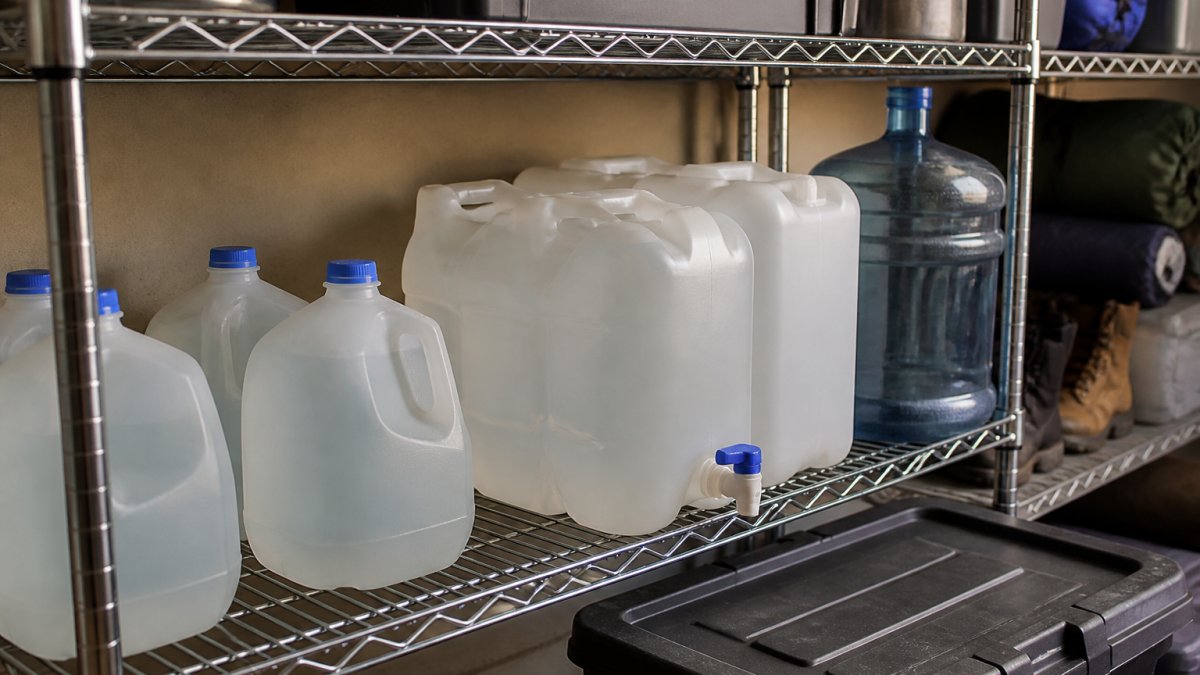
A common mistake is choosing a container by capacity alone. A 55-gallon drum sounds efficient until you can't move it, dispense from it, or rotate it on schedule. Match the container to your storage space, physical ability, and rotation plan.
1 Person 72-Hour Necessity Survival Kit with First Aid →
How to Store Emergency Water: Cleaning, Filling, Sealing, and Labeling
Clean and sanitize every container before it touches drinking water. A dirty container ruins clean water fast. Work through these steps in order.
- Wash the container with warm water and mild dish soap.
- Rinse thoroughly until no soap remains.
- Sanitize with a diluted bleach solution, then rinse again with clean water.
- Fill the container from a clean source, leaving a little headspace.
- Treat the water with a preservative if you want a longer window.
- Seal the cap tightly and check for leaks.
- Label each container with the fill date and contents.
A common mistake is skipping sanitizing because the container "looks clean." Clear containers hide biofilm, so sanitize every time.
How Much Water to Store for Emergencies
There's no single right number.
A common planning approach is to store a few days of water per person at minimum, then build toward a two-week supply. Hot climates and hard work push those needs up.
Count these uses, not just drinking:
- Drinking water
- Food prep and cooking
- Basic hygiene and handwashing
If you want a ready-made starting point, our 1 Person 72-Hour Necessity Survival Kit includes food and water supplies intended for 72 hours, plus water purification tablets and a hydration bag.

Temperature, Sunlight, and Storage Conditions That Shorten Shelf Life
Heat and light are the two biggest threats to stored water. A hot garage or sunny windowsill shortens shelf life faster than almost anything else: plastic can leach a faint chemical taste when warm, and light encourages algae growth.
Keep these conditions in mind:
- Cool storage. A basement or interior closet beats a hot garage.
- Dark storage. Block sunlight and bright room light.
- Away from chemicals. Never store water near fuel, paint, or solvents.
How to Inspect Stored Water and What to Do If It Looks or Smells Unusual
Inspection is a skill, not a glance. This section gives you a decision framework: what to check, what each finding suggests, and the action that matches.
The Inspection Sequence
Work in this order every time you open a container or consider using stored water.
- Check the container first. Look for cracks, bulging, a loose cap, or residue around the seal. A compromised container means the water inside is suspect regardless of how it looks.
- Look at the water. Pour a small amount into a clear glass. Note color, clarity, and anything floating or settled.
- Smell the water. A clean container should smell like nothing. Any odor is a signal.
- Do not taste stored water to determine whether it is safe. If the container, water source, or storage conditions are questionable, use an appropriate treatment method or replace the water.
What Each Sign Suggests, and What to Do
What You Observe |
What It May Mean |
Action |
|---|---|---|
Cloudy or murky |
Sediment, bacterial growth, or container breakdown |
Do not drink. Use for cleaning or flushing, or discard. |
Green tint or film |
Algae from light exposure |
Do not drink. Discard and move future storage to a dark location. |
Plastic or chemical odor |
Container leaching, especially after heat exposure |
Do not drink. Discard and replace the container. |
Rotten, musty, or sulfur smell |
Bacterial or organic contamination |
Do not drink. Discard. |
Flat taste, no odor, clear |
Normal aging; dissolved oxygen has escaped |
Flat taste alone does not indicate unsafe water. Only drink it if the water was properly stored and there is no reason to suspect contamination. |
Sediment at the bottom |
Mineral settling or container particles |
Strain through a clean cloth, then treat before drinking. |
Cracked or leaking container |
Contamination pathway |
Discard water. Replace container. |
The Key Distinction: Safety vs. Quality
Most stored water that "goes bad" has just lost quality, not safety. Water doesn't spoil the way food does; what changes is dissolved oxygen, which affects taste.
The dangerous cases are those where contamination had a pathway: a compromised seal, a non-food-grade container, untreated water stored too long, or heat exposure that degraded the plastic. There, appearance and smell may not tell the whole story.
When to Treat, When to Discard
- Treat if the water is clear and odorless but you're unsure about storage duration or the container's history. Boiling is the most reliable method. Water purification tablets are a practical backup when boiling isn't possible.
- Discard if there's any odor, color, film, or container damage. The cost of replacing water is trivial compared to the risk of illness during an emergency.
- Use for non-drinking purposes if the water is questionable but you need it for flushing, cleaning surfaces, or washing equipment. Label it clearly so no one drinks it by mistake.
For water you're unsure about, purification tablets offer a simple backup. Our survival kits include water purification tablets that each treat one liter of water, so you can stretch and refresh a supply when rotation isn't an option.
Prevention Beats Inspection
The best inspection is the one you rarely need. Store water in food-grade containers with tight seals, keep them cool and dark, label every fill date, and rotate on schedule, then inspection becomes a quick confirmation rather than a guessing game.
Frequently Asked Questions
How often should emergency water be replaced?
It depends on the source and container. Commercially sealed bottled water is typically rotated according to the manufacturer's date code, while water you fill yourself into clean, food-grade containers is commonly replaced every six months to a year. A simple habit is to pick two dates a year, such as when you change smoke detector batteries, and drain and refill every container you filled yourself. Always check the manufacturer's guidance for the specific container you use.
Can I store tap water long term?
Yes, tap water can be stored, but it does not keep indefinitely. Fill clean, sanitized, food-grade containers, seal them tightly, and store them somewhere cool and dark. Plan to drain and refill those containers on a regular rotation, commonly every six to twelve months. If your tap water is treated with chlorine, that residual disinfectant helps for a while, but it fades over time. Treat rotation as routine maintenance, not a one-time project, so your emergency water storage stays usable.
Does emergency water go bad in a sealed container?
Water itself does not spoil the way food does, but a sealed container is not a guarantee of quality. Over time, chlorine residual fades, plastic can affect taste and odor, and a compromised seal lets in contamination. Cool, dark storage slows those changes. If a sealed container has been stored for years, inspect it before relying on it: check for leaks, cloudiness, or an unusual smell. When in doubt, treat or replace the water rather than assume it is fine.
What should I do if stored water looks or smells unusual?
Do not drink it. Cloudiness, visible sediment, algae, or an off odor means the water quality has changed. Discard it, then clean and sanitize the container before refilling, and review your storage location for heat or sunlight exposure. For water you are unsure about, boiling or another appropriate treatment method can address biological concerns, but treatment will not fix chemical contamination. If you suspect chemical contamination, replace the water entirely and inspect the container for damage.


