


Last Updated: October 24, 2026
Quick Summary
An emergency response plan is a documented set of procedures your household follows during a crisis, a natural disaster, severe weather, power outage, or other sudden event. Creating one takes a few hours of focused work and includes identifying hazards, assigning roles, developing communication methods, planning evacuation routes, and building an emergency kit.
- Assign specific roles based on age and capability so every household member knows their responsibility during an emergency.
- Plan at least three communication methods ranked by reliability, including text messaging, an out-of-state contact, and a written contact card.
- Identify two evacuation routes from your home and designate two meeting places, one near home and one outside the neighborhood.
- Store your emergency kit in an accessible location every household member knows, not hidden in an attic or basement.
- Test your plan with drills under realistic conditions and record results to track whether readiness is improving over time.
Table of Contents
- Why Your Household Needs an Emergency Response Plan
- Identify Hazards and Threats Relevant to Your Area
- Assign Roles and Responsibilities
- Develop a Family Emergency Communication Plan
- Create an Evacuation Plan and Know Your Routes
- Build Your Emergency Kit Checklist and Supplies
- Use an Emergency Plan Template and Test Your Readiness
- Putting Your Plan Into Action
- Frequently Asked Questions
Why Your Household Needs an Emergency Response Plan
An emergency response plan is a documented set of procedures your household follows during a crisis, a natural disaster, severe weather, power outage, or other sudden event.
When an emergency strikes, you won't have time to figure things out.
Creating a household emergency response plan takes a few hours of focused work. This guide walks through each step, from identifying hazards to testing the plan.
Identify Hazards and Threats Relevant to Your Area
Start by listing the specific emergencies your household is most likely to face, matching your preparation to actual risk.
Human-caused hazards matter too, industrial accidents, hazardous materials incidents, transportation accidents, and civil unrest. If you live near a chemical plant, highway, or rail line, plan for those specific risks.
Make a written list of your top three to five hazards. This becomes the foundation for everything else in your plan.
Assign Roles and Responsibilities
Every household member needs to know what they're responsible for during an emergency. Unclear expectations create confusion when time is critical.
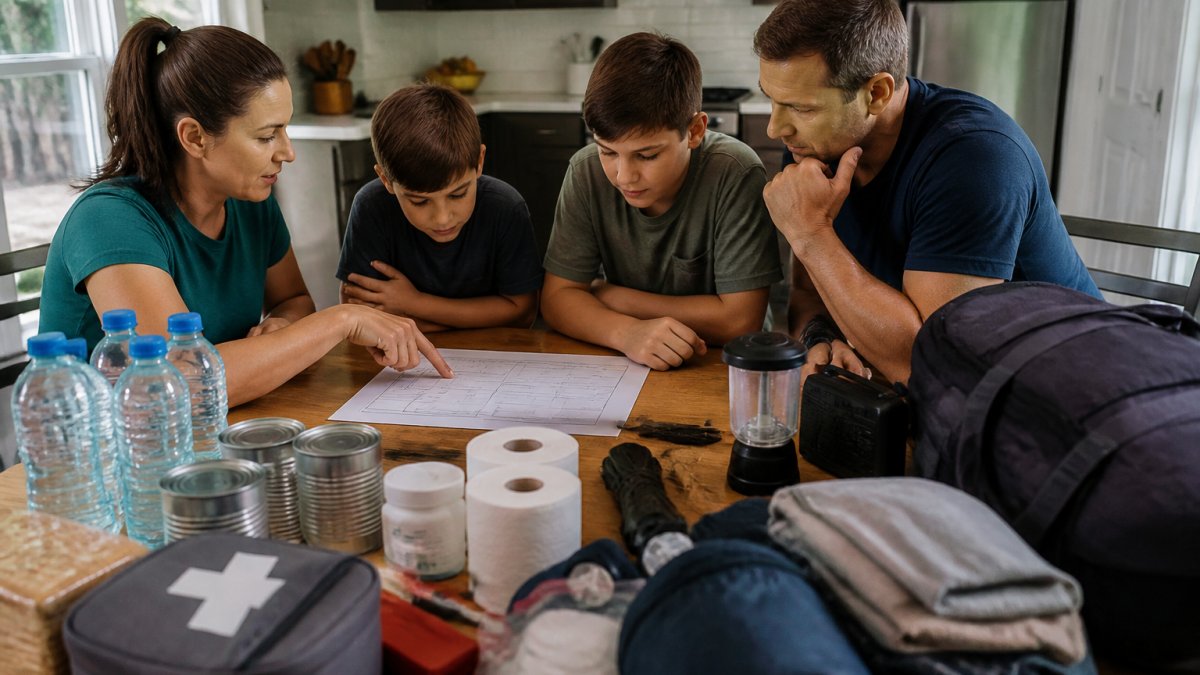
Include tasks like shutting off utilities, securing pets, gathering important documents, and helping anyone with mobility challenges.
Rotate some responsibilities annually so multiple people know how to handle critical tasks.
Develop a Family Emergency Communication Plan
When an emergency disrupts normal life, your family needs a way to reconnect. Cell networks often fail during disasters, and calling home immediately can overload the system. A resilient plan assumes the phones might not work.
Build Redundant Channels, Not One
Plan at least three ways to reach each other, ranked by reliability, and note which is primary and which is fallback:
- Text before voice. Short text messages often get through congested networks when calls fail, because they use less capacity. Agree that everyone texts a status update first, then calls only if needed.
- The out-of-state contact. Choose someone outside your immediate area who will answer and relay information. During a local disaster, out-of-state calls often work when local calls do not. Everyone should memorize that number, not just store it.
- A written contact card. Phone contacts are useless if the phone dies or is lost. Keep a paper list, out-of-state contact, workplace and school numbers, trusted neighbors, local emergency services, at home, in each wallet, and in each vehicle.
Plan for the Network and Power Failing
A communication plan that depends on a charged smartphone is one dead battery away from useless. Build in fallbacks:
- Battery independence. Keep a battery-powered or hand-crank AM/FM radio to receive emergency broadcasts, and a power bank or spare batteries for phones. A hand-crank radio can generate power by cranking, but battery requirements and operating time vary by model.A hand-crank radio needs no batteries at all.
- A no-signal protocol. Agree in advance what each person does if they cannot reach anyone: go to the near meeting place, wait a set period, then move to the second meeting place. Write the timing down so no one is guessing.
- A check-in window. Set a recurring time, for example, every even hour, when everyone tries to send a one-line status. This reduces repeated calling that congests the network further.
Account for Alerts and Warnings
Know how official warnings reach you and don't rely on a single channel. Wireless emergency alerts, NOAA Weather Radio, and local emergency management notifications are common; sign up for the local ones and confirm the settings are on. Treat an evacuation order as leave now and an evacuation warning as be ready to leave.
Include Everyone in the Plan
Communication plans fail for the people who are not in them. Account for:
- Children, who collects them from school or childcare, and the school's own release procedure.
- Older adults and people with disabilities, who checks on them, how they are reached, and what assistance they need to evacuate or shelter.
- People with limited English proficiency, identify a bilingual contact and note where translated alerts are available.
Document and Review It
Use the Emergency Communication Plan Template for Families to record contacts, channels, meeting places, and the no-signal protocol in one place. Share it with every household member, keep paper copies reachable without power, and review it at least annually and whenever a phone number, job, school, or household member changes.
Your household needs multiple ways to stay connected when normal communication fails.
Communication Method |
When to Use |
Key Advantage |
|---|---|---|
Text messaging |
Primary method |
Uses less network capacity than calls |
Out-of-state contact |
Fallback for local calls |
Often works when local calls fail |
Written contact card |
Phone lost or dead |
No power or signal required |
Physical meeting place |
Cannot reach anyone |
Everyone can find it without devices |
Battery-powered radio |
Receiving alerts |
Works without cell network |
Whistle |
Phones are down |
Signals for help or locates family |
Check-in window |
Reducing network load |
Scheduled time prevents repeated calling |
Create an Evacuation Plan and Know Your Routes
Many emergencies require leaving home quickly. An evacuation plan tells you when to leave, where to go, and what to take.
Identify two evacuation routes from your home, one primary and one backup. Walk or drive both, noting landmarks, street names, and timing. Know where they lead: higher ground if flooding is a risk, away from industrial areas if hazardous materials are a concern, or toward designated shelters.
Know where to go: some emergencies have designated public shelters, others require a friend's or family member's home outside the affected area.
Understand the difference between evacuation orders and warnings. An order means leave now; a warning means be ready to leave.
Post evacuation routes in your home so everyone knows them.
Build Your Emergency Kit Checklist and Supplies
An emergency kit keeps your household functional when normal services aren't available.
Water is the priority.
Light matters more than people expect.
Sanitation supplies include toilet paper, hand sanitizer, soap, trash bags, and feminine hygiene products.
Shelter and warmth items include blankets, emergency ponchos, and hand warmers if you live in a cold climate.
Ready-made kits handle much of this work. A 4 Person 72-Hour Necessity Survival Kit with First Aid provides core supplies for a household, with food, water, first aid items, light, and communication tools already assembled.

Use the How to Build a Family Emergency Kit: Step-by-Step guide to assemble your kit systematically, and reference the 10 Essential Items for a Home Emergency Kit to check for missed supplies.
Store your emergency kit in an accessible location every household member knows.
Use an Emergency Plan Template and Test Your Readiness
Writing your plan down forces clarity. A comprehensive emergency response plan documents your hazards, roles, communication contacts, evacuation routes, supply locations, meeting places, and out-of-state contact information, and specifies who is responsible for each task.
Most guides stop at "run a drill once a year." That is too vague to act on. The useful version is a repeatable workflow with a written record, so you can see whether readiness is improving or just being assumed.
A Reusable Planning Workflow
Build your plan in this order, keeping each step in the same editable document:
- Hazard list, your top three to five hazards, with a one-line note on what each would likely do to your household (loss of power, blocked roads, evacuation, shelter-in-place).
- Scenario cards, one short card per hazard covering the trigger (what you would see or hear), the decision (stay or go), the first three actions, and the meeting place that applies.
- Roles matrix, a simple table with household members down the side and tasks across the top (alert others, grab kit, shut off utilities, secure pets, assist anyone with mobility needs, contact out-of-state person). Mark primary and backup for each task.
- Contact and meeting-place page, out-of-state contact, local contacts, two meeting places, and the location of written copies.
- Supply inventory, what you have, where it is stored, and when it was last checked.
- Test log, the back page, where every drill and real event gets recorded.
That structure works for a household and scales to a small business, a school classroom, or a caregiver's plan for an older relative with minor edits to the roles matrix.
Turn Drills Into Measurable Tests
A drill without a stopwatch and a checklist is a rehearsal of optimism. Before each drill, write down what "good" looks like, then measure it. Indicators to track:
- Evacuation time, minutes from the alert to everyone at the outdoor meeting place, including grabbing the kit if it is safe to do so. Never delay escape or go back for supplies during a fire or other immediate danger.
- Recall, can each member state the out-of-state contact number and both meeting places from memory, without looking?
- Kit access, can the person on duty retrieve the kit and open it in the dark?
Record the result next to the target each time. A drill where evacuation took longer than planned is not a failure; it is data.
Close the Loop With Corrective Actions
Every gap found in a drill or real event should become a dated corrective action with an owner and a due date, for example, "replace expired batteries in the hallway flashlight, assigned to [name], by [date]." Keep a running list at the back of the plan, review open items at each six-month review, and close them out. This pattern separates a plan that improves from one that sits in a drawer.
Vary the Conditions
Test under conditions that resemble real disruptions, not ideal ones:
- Run one drill at night, when power is out and flashlights are the only light.
- Run one where the primary route is blocked and the backup route must be used.
- Run one where the usual communicator is unavailable and the backup must step in.
Keep the Template Alive
Store the plan where it can be edited, a printed master copy plus a digital copy, and treat the test log as part of the plan. A filled-in test log tells you at a glance whether your household is more ready this year than last.
Putting Your Plan Into Action
Creating an emergency response plan is the foundation; maintaining it is ongoing. Learn how to create a home disaster plan step by step to reinforce and expand on the household emergency planning process.
Review your plan every six months. Update contact information when people change jobs or phone numbers, refresh expired supplies, rotate stored water if you keep it long-term, and add or remove household members as needed.
Teach new household members the plan as soon as they join your family. Make sure visiting relatives or frequent guests know where the emergency kit is and what the meeting place is.
Keep copies in multiple locations: posted at home, in your car, in your wallet, and with your out-of-state contact.
An emergency response plan isn't a document you create and forget. It's a living guide that evolves as your household changes and as you learn from drills.
Frequently Asked Questions
What should be included in an emergency response plan?
An effective emergency response plan includes hazard identification for your area, assigned roles and responsibilities for each household member, emergency contact information and communication procedures, evacuation routes and meeting places, shelter-in-place procedures, and a list of emergency supplies. Your plan should also specify how you'll account for all family members and pets, and establish a way to receive emergency alerts.
How do you create a family emergency communication plan?
A family emergency communication plan designates an out-of-area contact person that all family members can call or text to report their status when local communications are disrupted. Write down this contact's phone number and keep copies with each family member. Include workplace phone numbers, school numbers, and locations where family members spend time regularly. Practice using this plan so everyone knows what to do and who to contact.
What should your evacuation plan include?
Your evacuation plan should identify multiple evacuation routes from your home and neighborhood, with street names clearly marked on a map. Designate an out-of-area meeting place where family members will gather if separated, and a local meeting place nearby. Plan how you'll evacuate with pets or family members with mobility challenges. Know where emergency shelters are located in your area and have transportation options identified in case you cannot use your vehicle.
How often should you review and practice your emergency response plan?
Review your emergency response plan at least twice per year and update it when family circumstances change, such as new jobs, school locations, or household members. Practice your plan through drills: conduct an evacuation drill, practice your communication plan by having family members call the designated contact, and review roles and responsibilities. These practice sessions help ensure everyone remembers the plan and identifies any gaps or issues before an actual emergency.
What is the difference between evacuation and shelter-in-place procedures?
Evacuation means leaving your home and area to reach safety, typically during threats like wildfires, flooding, or hazardous material incidents. Shelter-in-place means remaining indoors and sealing your home to protect against external hazards like severe storms, extreme heat, or air quality emergencies. Your plan should include clear decision points for when to evacuate versus when to shelter in place, based on the type of emergency and local authority guidance.
What emergency supplies should every household have on hand?
Basic emergency supplies include water (one gallon per person per day for several days), non-perishable food with a shelf life suitable for your household size, first aid supplies, flashlights, batteries, a battery-powered or hand-crank radio, medications and medical equipment, important documents in a waterproof container, cash, and a change of clothes and sturdy shoes per person. The specific quantities and items depend on your household size, any medical needs, pets, and the types of emergencies most likely in your area.
Creating a household emergency response plan gives your family the tools to handle crisis with clarity instead of panic. Start with identifying your specific hazards, assign clear roles, establish communication procedures, and build your supply kit. Test your plan regularly and update it as circumstances change. The time you invest now in preparation directly translates to how effectively your household responds when an emergency actually happens.


