


Table of Contents
- Go Bag Essentials: What to Include in Your Kit
- 72-Hour Emergency Kit Checklist: The Full Item List
- Emergency Document Organizer: Protecting Personal Identification
- Go Bag Essentials for Families: Adapting for Children and Pets
- Weight and Portability: How to Pack Without Overloading
- Comfort Items and Digital Preparedness
- How to Pack Your Go Bag: Step-by-Step
- Frequently Asked Questions
Last Updated: September 14, 2026
Go Bag Essentials: What to Include in Your Kit
A go bag is a pre-packed, portable kit of supplies that lets you leave your home quickly and stay self-sufficient for at least 72 hours. Building one around water, food, first aid, and communication gear covers the situations that matter most, whether that's an evacuation order, a wildfire, or a sudden power outage.

250-Piece Survival & First Aid Kit for Camping, Hiking & Outdoor Emergencies
This guide from Already Survival breaks down exactly what to include in a go bag, section by section, so you can pack with confidence instead of guesswork. Below, we'll show you the full item list, how to organize it, and how to keep the bag light enough to actually carry.
Most emergency guidance from agencies like Ready.gov's emergency supply checklist starts with the same foundation: water, food, and medication first. Everything else supports those three.
Water and Non-Perishable Food
Water is essential, but carrying a full three-day household water supply in one go bag may be impractical because of the weight. Keep a larger emergency water supply at home, and pack a practical amount of drinking water in your go bag based on what you can safely carry. Consider adding a portable water filter or purification method as a backup if you may need to evacuate on foot.
For food, choose shelf-stable, non-perishable options that need no cooking: 400-calorie food bars, nuts, dried fruit, and canned goods with a manual can opener. A common mistake is packing food that requires heat or added water. In an evacuation, you may have neither.
First Aid Kit and Prescription Medication
A first aid kit should cover cuts, burns, sprains, and allergic reactions: bandages, gauze, antiseptic wipes, blister treatment, pain relievers, antihistamines, and any personal prescriptions.
Pack at least a seven-day supply of prescription medication, rotated before it expires. What most guides miss is that pharmacies may be closed or inaccessible during an evacuation, so refills you "plan to grab later" are not part of your kit.
72-Hour Emergency Kit Checklist: The Full Item List
The 72-hour emergency kit checklist below reflects the standard three-day self-sufficiency window used by most preparedness agencies. Pack each category in its own labeled pouch so you can find items fast under stress. The quantities shown are per person unless noted otherwise.
- Water and food: Water and food: Pack a practical amount of drinking water that you can safely carry, along with a portable water filter or purification method as a backup. Include enough calorie-dense, shelf-stable food for up to three days, choosing options that require little or no cooking. Keep additional emergency water stored at home whenever possible.
- First aid: 25 adhesive bandages, 4 gauze pads, 1 roll medical tape, antiseptic wipes, blister treatment, 7-day supply of prescription medication, over-the-counter pain reliever and antihistamine.
- Lighting and power: 1 flashlight, 1 headlamp, 2 sets spare batteries per device, 10,000 mAh power bank, charging cables.
- Communication: battery-powered or hand-crank radio, emergency whistle, written emergency contact list.
- Documents: waterproof pouch with copies of ID, insurance cards, bank account numbers, and a family photo.
- Sanitation: hand sanitizer, bar soap, toothbrush, toothpaste, 6 waste bags, 1 roll toilet paper, menstrual supplies if applicable.
- Shelter: 1 emergency blanket, 1 poncho, 1 complete change of weather-appropriate clothing, sturdy shoes.
- Tools: multi-tool, 10 feet of duct tape, work gloves, N95 or KN95 dust mask.
Rotate perishables every six months. A simple system: check your kit when you change your clocks for daylight saving in March and November. Replace expired food, water, and medication, and test every battery-powered device.
Tools, Lighting, and Communication Gear
Lighting fails first, so pack both a flashlight and a headlamp, plus spare batteries. A battery-powered radio keeps you connected to emergency broadcasts when cell networks overload. The National Oceanic and Atmospheric Administration (NOAA) broadcasts weather alerts continuously on dedicated frequencies, and a hand-crank radio with NOAA bands costs little and never needs batteries.
A multi-tool, duct tape, and a dust mask handle repairs, shelter patching, and debris protection.An emergency whistle can signal for help with far less effort than shouting. Three short blasts are widely recognized as a distress signal in many outdoor emergency situations.
Sanitation, Hygiene, and Shelter Supplies
Hygiene supplies prevent illness when clean water is scarce: hand sanitizer, soap, toothbrushes, and waste bags. Pack a small supply for each person, not one shared kit. A common oversight is toilet paper and menstrual products, both are lightweight and make a real difference in comfort and dignity during an evacuation.
For shelter, an emergency blanket and a poncho take almost no space but retain body heat and block rain. If you have room, a compact tent or bivy adds real protection in cold or wet conditions. A Mylar emergency blanket can help reduce heat loss by reflecting radiant body heat, but the thin material can tear easily. Inspect it after use and replace it if it is damaged.
Emergency Document Organizer: Protecting Personal Identification
An emergency document organizer is a waterproof pouch or folder that holds copies of the personal identification and records you would need to rebuild your life after a disaster. Keep originals in a fireproof safe at home and copies in your go bag.
Include:
- Copies of driver's licenses, passports, and birth certificates
- Insurance policies (health, home, auto)
- A written emergency contact list, not just contacts saved in your phone
- Bank and credit card account numbers
- A recent photo of each family member and pet
Digital copies stored in encrypted cloud storage add a backup layer, but paper copies still work when the power is out. According to FEMA's guidance on financial preparedness, keeping copies of critical documents is one of the most overlooked steps in household emergency planning.
Go Bag Essentials for Families: Adapting for Children and Pets
Go bag essentials for families change once children and pets are in the picture. Children need their own scaled-down supplies, and pets need food, water, medication, and proof of vaccination. The biggest gap in most family guides is treating "children" as one category, a 6-month-old and a 12-year-old have almost nothing in common when it comes to evacuation supplies.
Infants (0-12 months)
- 3 days of formula or breast milk storage bags, plus a manual pump if needed
- 20 diapers and 200 wipes (roughly 6-8 diapers per day)
- 2 pacifiers, 2 bottles, and a small bottle of dish soap for cleaning
- 2 full changes of clothing, including a hat and socks
- A baby carrier or wrap, strollers are useless on rough terrain or in crowds
- Infant pain reliever and a nasal aspirator
Toddlers and Young Children (1-5 years)
- 3 days of shelf-stable snacks they will actually eat (crackers, fruit pouches, cereal bars)
- 10 diapers or pull-ups if not yet potty-trained
- 2 changes of clothing, including a jacket
- A comfort item, a favorite small toy, blanket, or stuffed animal
- A written card with their name, your name, and a phone number in case you are separated
Older Children and Teens (6-18 years)
- Their own water and food portions (teens eat adult-sized portions)
- A deck of cards, a book, or a small game to combat boredom
- A phone charger and, if they have a phone, a written backup contact list
- Any prescription medication, plus a copy of the prescription
- A small flashlight they can keep in their own pocket
Pets
For pets, include a leash, carrier, three days of food, a collapsible bowl, and vaccination records.Before an emergency, identify pet-friendly shelters, hotels, boarding facilities, or friends and family outside your area who could accommodate your pets. During an evacuation, confirm availability and pet policies before traveling whenever possible. The American Red Cross and FEMA both maintain pet-friendly shelter directories, and many hotels waive pet policies during declared emergencies, call ahead if you can.
Packing for Multiple People
A family of four can easily end up with 80 pounds of gear if each person carries a full 72-hour kit. Split the load: adults carry water, food, and shelter; children carry their own clothing, comfort items, and a small flashlight. Keep one shared document organizer with copies of everyone's ID, insurance, and vaccination records. If you have a child with mobility needs, a wagon or jogging stroller with pneumatic tires handles debris and uneven ground far better than a standard stroller.
Weight and Portability: How to Pack Without Overloading
Weight is where most go bags fail. A bag you cannot carry for a mile is not an evacuation bag; it is a storage box. Keep your go bag as light as practical while still covering essential needs. A comfortable carrying weight varies by person, so consider your age, fitness, mobility, terrain, and how far you may need to travel.
Trim weight by:
- Choosing water pouches over bottles
- Packing calorie-dense bars instead of canned food where possible
- Splitting the load across family members
- Using a pack with a padded hip belt and load lifters
A common mistake is overpacking "just in case" gear you have never tested. If you have not carried the bag around the block, you do not know whether it works.
Comfort Items and Digital Preparedness
Comfort items and digital preparedness are the two categories most lists skip entirely, yet both matter in a real evacuation. Stress and boredom wear people down, and a dead phone cuts off your communication plan.
Pack small comfort items: a deck of cards, a book, a journal, or a favorite snack. They cost almost no weight and help children and adults stay calm.
For digital preparedness, include:
- A power bank with enough capacity to recharge a phone several times
- Charging cables for every device in the household
- A USB drive with scanned documents and important photos
- A printed copy of your evacuation route and out-of-area contacts
How to Pack Your Go Bag: Step-by-Step
Packing a go bag takes about 30 minutes once your supplies are gathered. The goal is a bag that is organized, balanced, and ready to grab and go without repacking.
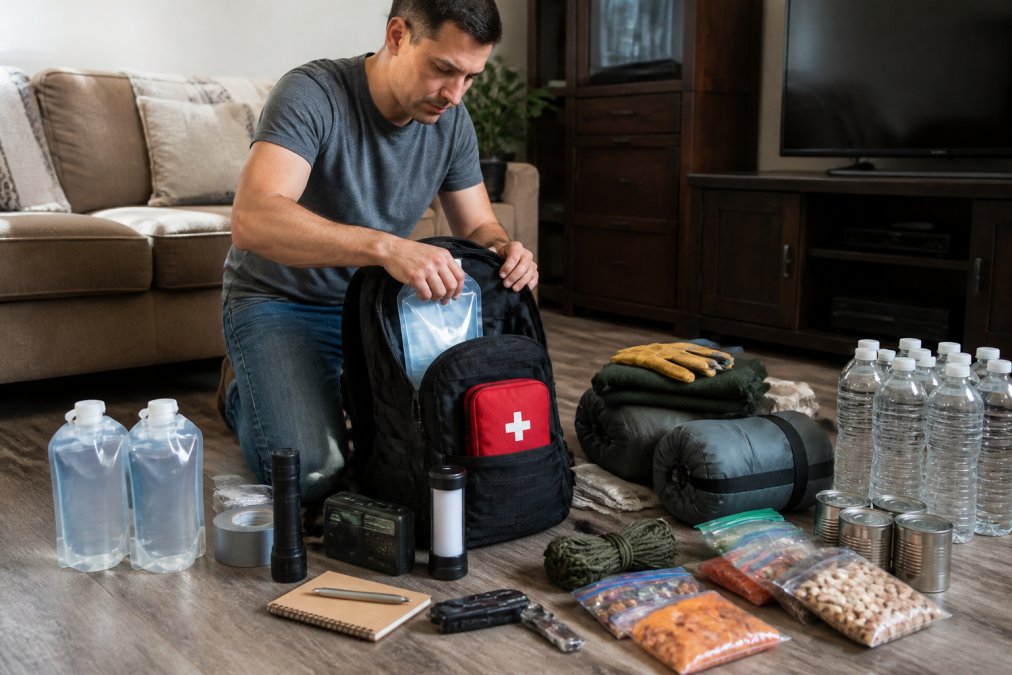
A person kneeling on a living room floor, packing a sturdy backpack with water pouches, a first aid kit, and a flashlight, with other gear arranged neatly around them
Step 1: Lay out every item by category. Group water, food, first aid, tools, documents, and clothing so you can see gaps before packing.
Step 2: Pack heavy items closest to your back. Water and food go in the center of the pack, near your spine, to keep the load balanced.
Step 3: Keep essentials in outer pockets. First aid, flashlight, and your document organizer belong where you can reach them without unpacking.
Step 4: Protect documents and electronics. Seal paper documents in a waterproof bag and wrap electronics in a dry sack.
Step 5: Test the fit. Put the bag on, adjust the straps, and walk a mile. If it pulls on your shoulders, redistribute the weight.
Step 6: Store it where you can grab it. Keep the bag near an exit, not buried in a closet. Check it every six months and rotate food, water, and medication.
The American Red Cross recommends reviewing your emergency supplies regularly and replacing expired items as needed.
Emergencies rarely give you time to shop, sort, and pack. The families who move fastest are the ones who built their kit before they needed it, and that is exactly where Already Survival can help. Our Elite Bug Out Bag arrives pre-packed with 72 hours of food and water, a first aid kit, and survival tools, and our 1 Person Essential Survival Kit gives solo preppers a lighter, simpler starting point. Every order ships free, payments are encrypted, and unused items can be returned within 30 days. Search our site and get your go bag ready before you need it.


Frequently Asked Questions
What are 10 essential items for a go bag?
A basic go bag should include water pouches, non-perishable food bars, a first aid kit, a flashlight, a battery-powered radio, a power bank, a multi-tool, a dust mask, personal identification copies, and cash in small bills. These items cover hydration, nutrition, medical needs, communication, and identification for at least 72 hours. Add weather-appropriate clothing and sturdy footwear based on your region.
How long should a go bag be designed to last?
Most go bags are built to sustain one person for 72 hours, which is the standard window for evacuation or shelter-in-place scenarios before outside help arrives. The 72-hour emergency kit checklist typically includes three days of food and water. If you live in a region prone to extended outages or remote areas, extend supplies to five to seven days and rotate them regularly.
What documents should be included in a go bag?
Store copies of personal identification, insurance policies, medical prescriptions, emergency contact list, and financial documents in a waterproof emergency document organizer. Include a USB drive with digital copies and a small amount of cash reserves. Never store original documents in a go bag unless you have duplicates elsewhere. Update the organizer every six months to keep information current.
What is the difference between a go bag and a stay-at-home kit?
A go bag is portable and designed for evacuation, so it prioritizes lightweight, compact gear you can carry. A stay-at-home kit is larger and supports sheltering in place with more food, water, and comfort items. Both should include first aid supplies and a communication plan, but only the go bag needs to be grab-and-go ready at a moment's notice.
How do you customize a go bag for children or pets?
Go bag essentials for families include child-sized clothing, diapers or formula, a favorite comfort item, and any prescription medication. For pets, add food, water, a leash, and vaccination records. Pack each family member's items in a separate labeled pouch so anyone can grab what they need quickly. Review and resize the bag as children grow.
How often should you rotate items in your go bag?
Check your go bag every six months. Replace expired food and water, test flashlights and batteries, update prescription medication, and refresh documents in your emergency document organizer. A good habit is to review it each daylight saving time change. Kit maintenance keeps your supplies reliable when you actually need them.


