


Table of Contents
- What Home Water Filtration Actually Removes
- Types of Home Water Filtration Systems
- Water Purification vs Filtration: What's the Difference?
- Emergency Water Storage for Home: Where Filtration Fits In
- Portable Water Filters for Survival and Travel
- How to Choose the Right System for Your Household
- Frequently Asked Questions
Last Updated: October 1, 2026
What Home Water Filtration Actually Removes
Water filtration is the process of passing water through a physical or chemical barrier that captures contaminants while letting clean water through. If you have ever wondered why you need a water filtration system at home, the answer starts with what comes out of your tap. This guide from Already Survival walks through what filtration catches, what it misses, and how to match a system to your household.
Most municipal supplies meet federal safety standards, yet that does not mean the water arriving at your kitchen sink is free of everything you would rather not drink. EPA drinking water standards overview sets legal limits for a defined list of contaminants, not a guarantee of zero.
Contaminants That Commonly Show Up in Tap Water
The list of potential contaminants is longer than most people expect. Common categories include:
- Sediment and particulates, rust, sand, and silt picked up from aging pipes
- Chlorine and chloramines, disinfectants added during treatment
- Lead, leached from older service lines and household plumbing
- Heavy metals, including mercury and arsenic in some regions
- Volatile organic compounds (VOCs), industrial solvents and byproducts
- Microplastics and pathogens, tiny particles and naturally occurring organisms
- Hard minerals, calcium and magnesium that create scale buildup
What Filtration Cannot Remove
No single filter handles everything. Standard carbon filters capture chlorine, many VOCs, and some sediment, but they do not reliably remove dissolved minerals, nitrates, or pathogens. Reverse osmosis strips a broad range of dissolved solids, yet it also removes beneficial minerals and wastes a portion of the water it processes. Boiling kills pathogens but concentrates minerals and does nothing for chemical contaminants. Understanding these gaps prevents false confidence.
Types of Home Water Filtration Systems
Home filtration systems fall into a few broad categories, and each one fits a different situation. The more useful way to compare them is by the technology inside the cartridge, because the technology, not the form factor, determines what the system can actually remove.
Filtration Technologies and What They Target
Activated carbon works through adsorption: contaminants bind to the vast internal surface area of the carbon. It is effective against chlorine, many volatile organic compounds, and the compounds responsible for taste and odor. Standard carbon blocks do not reliably remove dissolved minerals, nitrates, or pathogens.
Point-of-Use vs. Point-of-Entry
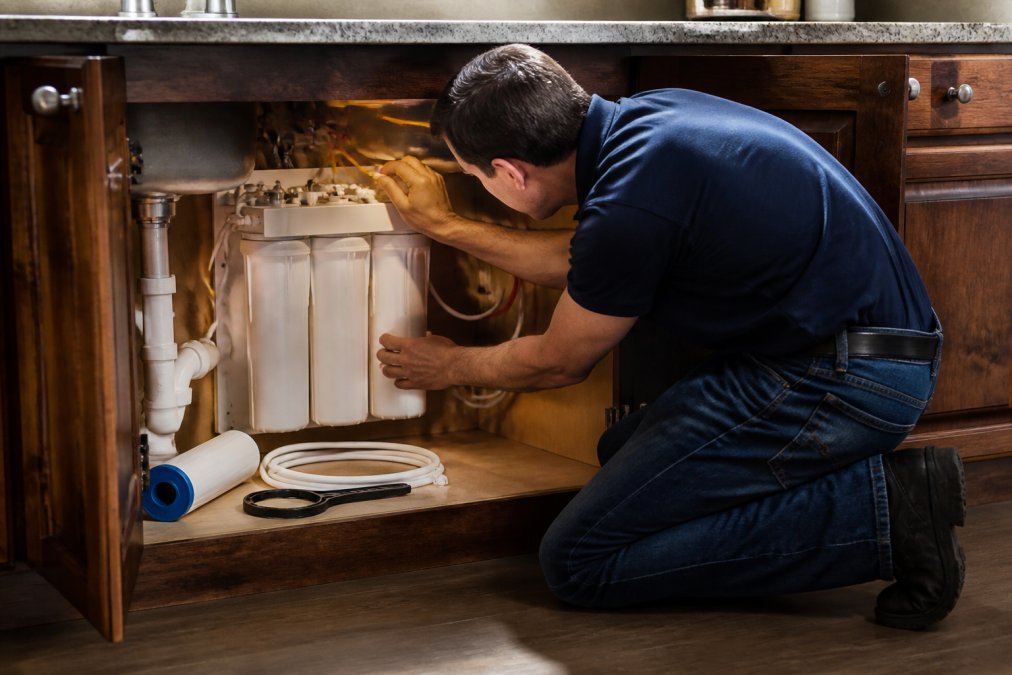
Point-of-use systems treat water at a single tap. Pitchers, faucet mounts, and under-sink units are the most common examples. They are simpler to install and maintain, but they only protect the water you draw from that one fixture.
System Type |
Typical Technology |
Treats |
Best For |
Maintenance |
|---|---|---|---|---|
Pitcher / countertop |
Activated carbon |
Single tap |
Renters, small households |
Frequent cartridge swaps |
Faucet mount |
Activated carbon |
Single tap |
Quick installation |
Monthly to quarterly |
Under-sink |
Carbon, RO, or multi-stage |
Single tap, hidden |
Kitchens, cleaner look |
Every 6-12 months |
Whole-house |
Sediment + carbon, sometimes ion exchange |
All household water |
Scale, sediment, plumbing |
Annual service |
UV inline |
Ultraviolet |
Single tap or whole-house |
Pathogen concerns on questionable sources |
Lamp replacement on schedule |
Matching Technology to the Problem
The trade-off is straightforward: point-of-use systems are simpler and easier, while point-of-entry systems cover more ground. But the technology choice matters more than the form factor. If chlorine and taste are the issue, carbon is the right tool. If lead or arsenic is the concern, RO or a specialized media is more appropriate. If hardness is scaling your fixtures, ion exchange is the answer.
Water Purification vs Filtration: What's the Difference?
Water filtration and water purification are not the same thing, and the distinction matters when you are comparing products. Filtration physically or chemically removes contaminants by trapping them in a medium such as activated carbon or a ceramic element. Purification goes further and is meant to render water microbiologically safe by eliminating pathogens, often through distillation, UV treatment, or a combination of methods.
Emergency Water Storage for Home: Where Filtration Fits In
Emergency water storage for home is about having a plan before you need it. Filtration and storage work as a pair: you store water for the first days, and you filter additional or questionable water as the situation stretches on.
A few practical points to keep in mind:
- Store water in food-grade containers, kept cool and out of direct sunlight
- Rotate stored water on a regular schedule so it does not sit indefinitely
- Keep a filter that works without electricity, since outages often accompany the emergencies that cut water service
- Label containers with the date you filled them
Portable Water Filters for Survival and Travel
Portable water filters for survival and travel cover the gap between your home supply and the outside world. These are compact devices you carry in a pack, glove box, or Go Bag, designed to treat water from sources you would not otherwise trust.
- Squeeze filters, lightweight, ideal for hiking and backpacking
- Pump filters, good for larger volumes and group use
- Straw filters, minimal weight, drink directly from the source
- Gravity bags, set them up at camp and let gravity do the work
How to Choose the Right System for Your Household
Choosing a system comes down to three questions: what is in your water, how much water you use, and what you are preparing for. The first question is the one most households skip, and it is the one that determines everything else.
Start With Your Local Water Quality Report
If you are on a municipal supply, your water utility is required to publish an annual Consumer Confidence Report (CCR), sometimes called a water quality report (the EPA). The EPA guide to Consumer Confidence Reports explains what these reports contain and how to read them. The CCR lists the contaminants the utility detected, the levels found, and the legal limit for each.
When you read a CCR, focus on three things:
- Detected contaminants and their levels. A contaminant listed at a level well below the legal limit is different from one detected near the limit.
- The source of your water. Surface water (rivers, lakes, reservoirs) and groundwater (wells, aquifers) carry different contaminant profiles and different treatment needs.
- Disinfectant residuals. Chlorine or chloramine levels tell you whether a carbon stage will meaningfully improve taste and odor.
Test What the Report Does Not Cover
A basic water quality test identifies hardness, pH, chlorine, and common contaminants, giving you a factual starting point instead of guesswork. Home test kits and lab mail-in tests are both widely available. For private wells, testing is the only way to know what is in your water, since no utility report exists. Test for the contaminants that matter in your area, your state or county health department can often tell you which ones are common locally.
Match the System to Your Findings
Once you know what is in your water, the choice becomes clearer:
- If taste and chlorine are the main complaints, a carbon-based point-of-use filter is usually enough
- If you see scale on fixtures or appliances, a whole-house system targeting hardness makes sense
- If lead or arsenic shows up in testing, look for a system with RO or a media specifically rated for that contaminant
- If you are preparing for emergencies, prioritize a non-electric filter plus stored water
- If you have specific health concerns or a private well, consult a water professional before deciding
Plan for Maintenance Before You Buy
Every filter has a cartridge replacement schedule, and a clogged or expired cartridge stops doing its job. Note the replacement interval when you buy, and keep a spare on hand so you are never caught without one. For whole-house systems, factor in annual service. For UV systems, the lamp has its own replacement cycle. A system you cannot maintain is a system that stops protecting you.
Frequently Asked Questions
Do I really need a water filtration system at home?
It depends on your water source and household needs. Municipal water is treated to meet safety standards, but aging pipes, source water changes, and local conditions can affect what comes out of your tap. A filtration system gives you more control over taste, odor, and specific contaminants like chlorine, sediment, or lead. If you store emergency water or want backup during outages, filtration also supports your preparedness plan. Testing your water first helps you decide what level of filtration makes sense.
What are the downsides of a water filtration system?
Filtration systems require ongoing maintenance, including cartridge replacement on a regular schedule. Some types, like reverse osmosis, use more water than they produce and can strip beneficial minerals. Whole-house systems cost more upfront and may need professional installation. Without regular maintenance, filters can become less effective or even harbor bacteria. The key is matching the system to your actual water quality and committing to the maintenance cycle the manufacturer recommends.
How does water filtration fit into an emergency preparedness plan?
Water is one of the first supplies to run short during power outages, boil-water advisories, or natural disasters. Storing water at home covers short-term needs, but filtration lets you treat water from uncertain sources if your stored supply runs out. Portable water filters for survival are lightweight and can make water from streams, lakes, or questionable taps drinkable. Combining stored water, a home filtration system, and a portable backup gives you layered protection for different scenarios.
What types of contaminants can home water filters address?
Different filtration technologies target different contaminants. Activated carbon filters reduce chlorine, chloramines, and many volatile organic compounds that affect taste and odor. Reverse osmosis removes a wide range of dissolved solids, including lead, fluoride, and heavy metals. Sediment filters capture dirt and rust particles. Ion exchange softens hard minerals like calcium and magnesium. No single system removes everything, so understanding your water quality helps you choose the right combination.


